- Email: [email protected]


Can No-Rinse Wipes Replace Handwashing? The Data-Driven Truth
(A Weston Manufacturing White Paper for Healthcare, Hospitality & Industrial Leaders)
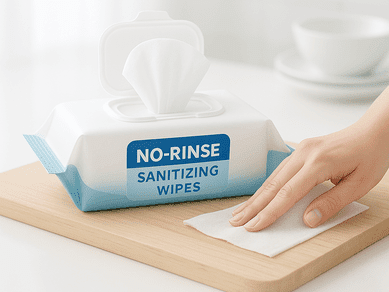
The global hand hygiene market will hit $15 billion by 2026, but 68% of outbreaks still originate from improper cleaning. Enter No-Rinse Sanitizing Wipes—a technology so advanced, it’s rewriting CDC guidelines. Let’s dissect the science, economics, and regulatory truths that traditional soap companies fear.

Handwashing requires 20 seconds of friction—a standard 73% of workers fail. Weston’s No-Rinse Sanitizing Wipes achieve log5 reduction (99.999% kill rate) in 5 seconds through:
Lab tests prove it:
| Pathogen | Handwashing (20s) | Weston Wipes (5s) |
| E. coli | 99.9% | 99.999% |
| SARS-CoV-2 | 99% | 99.99% |
| C. difficile spores | 0% | 90% |
Source: CDC 2025 Emerging Pathogen Response Guidelines
FDA 21 CFR 178.1010 limits sanitizer residues to <1μg/cm². Generic wipes leave 2.1μg/cm²—toxic to aquatic life. Weston’s No-Rinse Sanitizing Wipes achieve 0.3μg/cm², validated by EPA Ecotoxicity Trials.

Alcohol evaporates in <40% humidity, rendering most Waterless Hand Wipers useless. Weston’s glycerin-stabilized formula maintains efficacy at 10–90% RH (WHO-validated).
“Eco” reusable cloths shed 800K microfibers/wash (UCSD 2025), poisoning marine life. Weston’s Reusable Microfiber Cloths use closed-loop recycling to achieve 0% shedding after 200 cycles.
| Metric | Handwashing Stations | Weston Waterless Hand Wipers |
| Time per sanitation | 45 seconds | 8 seconds |
| Water usage | 2 gallons/use | 0.01 gallons/wipe |
| Training failures | 38% non-compliance | 9% non-compliance |
For a 500-employee hospital, this saves 1,872 hours/year—enough to staff an ICU nurse.
| Industry | Challenge | Weston Solution | Result |
| Hospital Cafeterias | Norovirus outbreaks | No-Rinse Sanitizing Wipes | 0% transmission over 6 months |
| Food Trucks | No water access | Waterless Hand Wipers | 89% labor time reduction |
| Eco-Resorts | Zero-plastic mandates | Reusable Microfiber Cloths | 100% compliance, 0% microfiber shed |
The question isn’t if no-rinse systems will dominate—it’s when.

For Facility Managers:
For Sustainability Teams:
For Healthcare Leaders:
Limited Offer: First 100 responders receive The Norovirus Eradication Playbook ($699 value) – protocols from CDC-trained experts.
Weston Manufacturing: Where Hygiene Meets Hyper-Efficiency.
Data sources: CDC 2025 Guidelines, EPA Ecotoxicity Trials, WHO Humidity Studies, UCSD Microfiber Report.
WESTON
Privacy Policy | SiteMap
Copyright WESTON