- Email: [email protected]


Stitched non-woven fabrics rarely get attention. They don’t shine, stretch dramatically, or promise miracles. Yet across many industries, they solve problems quietly and effectively.
Unlike thermally bonded or chemically bonded non-wovens, stitched non-woven fabric relies on mechanical reinforcement. Fibers are held together by stitching yarns rather than heat or resin. That single difference changes how the material behaves under stress, moisture, and repeated use.
Below are five applications that show how this structure works in practice—along with its strengths and limits.

In protective clothing, fabrics often fail first at stress points—knees, elbows, seams, and folds. Stitched non-woven fabric is frequently used as an internal reinforcement layer rather than a visible surface.
Advantages
Stitching distributes tension across the fabric
Maintains flexibility during movement
Performs well under repeated bending and compression
Less prone to fiber breakage compared to needle-punched alternatives
Limitations
Not as abrasion-resistant as tightly woven outer shells
Requires pairing with surface fabrics for long-term exposure
Slightly heavier than meltblown layers with similar thickness
This balance makes stitched non-woven fabric useful where durability matters more than appearance—industrial coveralls, protective liners, and safety garments.
Most furniture fabrics rely on unseen layers to maintain shape over time. Stitched non-woven fabric often appears behind cushions, under upholstery, or as mattress support material.
Advantages
Holds fiber structure steady under long-term pressure
Allows airflow, reducing trapped moisture
Resistant to deformation compared to loose-laid non-wovens
Lightweight while offering dimensional stability
Limitations
Not designed as a decorative surface
Can fray at cut edges without proper finishing
Lower tear strength than woven scrims in extreme load scenarios
Its role is quiet but critical. Without it, foam shifts, cushions collapse faster, and furniture loses comfort sooner.
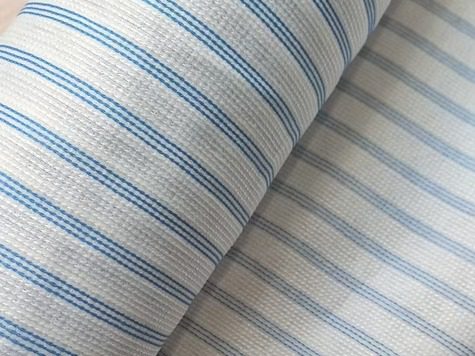
In agriculture, materials must survive wind, handling, moisture, and sunlight—often all at once. Stitched non-woven fabric is used for crop covers, soil stabilization, and plant protection sheets.
Advantages
Breathable to air and water
Stitching improves wind resistance
Maintains coverage without sealing the soil
Easier to handle than rigid woven nets
Limitations
UV resistance depends on fiber selection
Not as long-lasting as heavy woven ground cloth
Stitch yarn can weaken if exposed to harsh chemicals
For seasonal or mid-term use, stitched non-woven fabric offers a balance between protection and plant-friendly permeability.
In many filtration systems, the filter media itself cannot hold shape under airflow or liquid pressure. Stitched non-woven fabric is commonly used as a structural support layer.
Advantages
Maintains pore stability during operation
Prevents collapse under pressure
Compatible with multi-layer filter designs
Mechanical bonding avoids resin contamination
Limitations
Not a fine filtration layer on its own
Stitch pattern affects flow uniformity
Requires careful design for precision filtration
This makes stitched non-woven fabric a reliable backbone in HVAC filters, industrial air systems, and liquid filtration assemblies.
During transport, products often need protection that cushions without trapping moisture. Stitched non-woven fabric is used as protective wraps, separators, and reusable padding.
Advantages
Soft surface reduces scratching
Better tear resistance than standard spunbond
Reusable in controlled logistics cycles
Lightweight compared to foam alternatives
Limitations
Limited impact absorption for heavy shock
Stitching can imprint on very soft surfaces
Requires proper storage to avoid contamination
In industrial packaging, reliability often matters more than aesthetics, and this fabric fits that role well.
| Property | Stitched Non-Woven Fabric | Spunbond Non-Woven | Woven Fabric |
| Structural Stability | High | Medium | Very High |
| Breathability | High | Medium | Low–Medium |
| Flexibility | Medium–High | High | Low |
| Tear Resistance | Medium–High | Medium | Very High |
| Chemical Dependency | Low | Low | None |
| Typical Role | Support / Reinforcement | Surface / Disposable | Load-bearing |
This comparison shows why stitched non-woven fabric often fills the space between disposable layers and rigid woven materials.
The performance of stitched non-woven fabric depends heavily on fiber selection—polyester, viscose, blends—and stitch density.
Some manufacturers, including Weston Manufacturing, apply water-entanglement and stitch-bonding techniques together to improve fiber cohesion while preserving softness. In these cases, stitched non-woven fabric benefits from both mechanical stability and controlled fiber distribution, particularly in technical and industrial-grade applications.
This approach is most relevant where consistency matters more than surface appearance.
Across industries, the same pattern repeats. Designers need materials that:
Hold shape without rigidity
Allow airflow without falling apart
Survive handling without complex treatments
That is where stitched non-woven fabric earns its place. Not as a hero material, but as a dependable one—working behind the scenes, holding systems together, and doing exactly what it was engineered to do.
WESTON
Privacy Policy | SiteMap
Copyright WESTON