- Email: [email protected]


You’re at the store, grabbing supplies for an elderly parent. The adult incontinence pads are three aisles over, but the pet section is right here — and the puppy pee pads look nearly identical. Same plastic backing, same fluffy white surface, roughly similar size. You think: can these really be that different?
It’s a fair question. And the honest answer is: they share the same basic idea, but the details matter more than the packaging lets on.
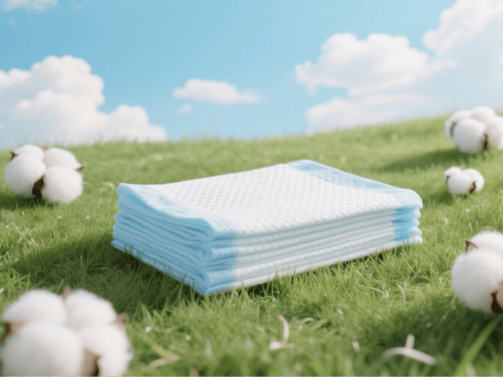
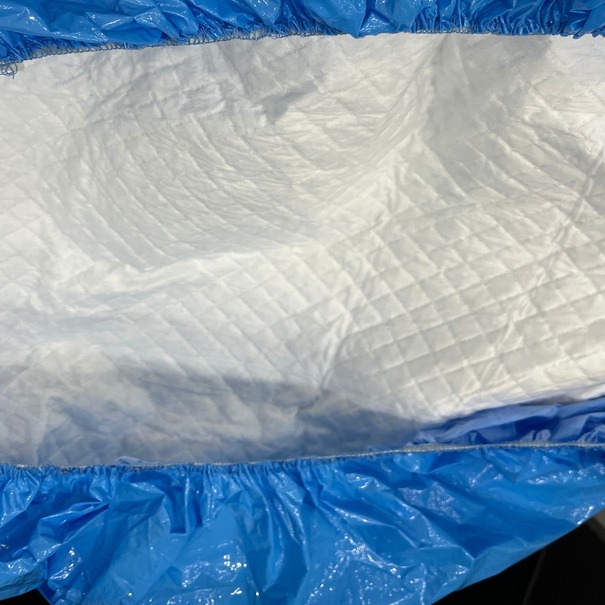
Both adult incontinence pads and pet pee pads use a layered construction built around one job: pull liquid in fast, hold it, and don’t let it leak back out.
The typical structure looks like this:
At this structural level, yes — they’re similar. The SAP chemistry is largely the same. The leak-proof backing works the same way. This is why the question is worth asking, and why the answer can’t just be a flat “no.”
The difference shows up in two places: what the top layer is made of, and what additives are present.
| Feature | Adult Incontinence Pads | Pet Pee Pads |
| Top layer material | Skin-safe nonwoven (cotton, viscose, lyocell) | Standard nonwoven, no dermal requirement |
| Regulatory oversight | FDA-regulated (Class I medical device, US) | No FDA oversight required |
| Fragrance additives | Usually fragrance-free or tested for skin | Often contain attractant scents for animals |
| Skin pH compatibility | Designed for prolonged skin contact | Not designed for skin contact |
| Softness standard | Clinical-grade softness requirements | No formal softness standard |
| Use position | Body-worn or placed under patient | Floor or crate use only |
The attractant scent issue is worth pausing on. Many pet pads add fragrance compounds specifically to guide animals toward the pad. Those same compounds, pressed against human skin for hours, can trigger irritation — especially in elderly users or anyone with compromised skin integrity.
A puppy walks across a pet pad and moves on. An adult using an incontinence pad may be in contact with that material for an extended period — sometimes hours at a time.
That sustained exposure changes the risk profile entirely. Dermatologists have a name for what can happen when skin sits too long against an incompatible material combined with moisture: incontinence-associated dermatitis (IAD). It’s a real, painful, and preventable condition. The top layer material directly influences whether that risk goes up or down.
This is where the choice of nonwoven fabric matters practically, not just on paper. A top layer made from 100% cotton, lyocell, or viscose — materials that are inherently soft, breathable, and low-irritant — behaves very differently against skin than a standard polypropylene nonwoven used in a floor pad.
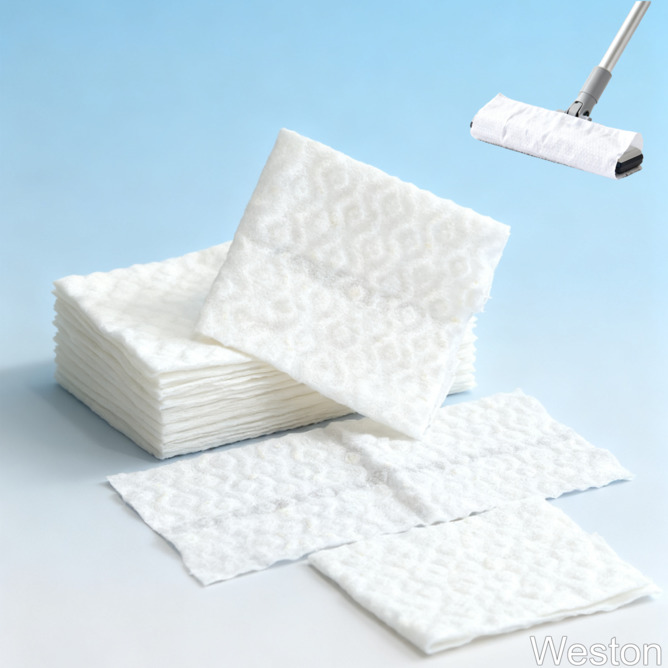
Manufacturers like Weston Manufacturing, a spunlace nonwoven factory with over 20 years of production experience, supply the raw materials that make this difference real. Their fabric options — including 100% viscose, bamboo fiber, 100% cotton, PLA, and lyocell — are used specifically in applications where skin safety and softness are non-negotiable. These materials can be finished hydrophilic (for quick fluid absorption) or with a soft-touch treatment for added comfort, and they’re used in both disposable and durable pet pee pads formats.
It’s a useful reminder that what separates a high-quality pad from a mediocre one often starts at the fabric supplier level — long before the product hits a retail shelf.

Not all adult products are body-worn. Bed underpads — sometimes called chux — are placed under a patient on a mattress or chair. In this case, the pad isn’t in direct skin contact; it’s acting more like a protective layer between the patient and the surface.
In this scenario, the comparison to a pet pad gets closer. Both are functioning as surface protectors. The risk profile is lower. That said, if a patient shifts and ends up lying on the pad directly, the same skin contact concerns apply.
Neither product type is required to disclose every ingredient in most markets. That makes label-reading more of an art than a science. A few things to look for:
For caregivers sourcing pads in volume — especially for clinical or home care settings — it’s worth tracing the material back to the nonwoven supplier. A pet cleaning finger wipes supplier working with quality spunlace fabrics, for instance, will use the same material standards that matter in incontinence products. The supply chain often overlaps more than consumers realize.
For direct, prolonged skin contact: adult incontinence pads are designed for that job; pet pads are not. The regulatory gap, the potential for skin irritants, and the lack of dermal safety testing make pet pads a poor substitute in this context.
For surface protection only — a pad under a chair cushion, on a mattress protector, or as a backup layer — the risk is lower, though it still depends on what’s in the pad.
The broader point: these products look alike because they solve a similar physical problem. But the human body, especially aging or sensitive skin, has requirements that a floor pad was never engineered to meet. Knowing that distinction helps caregivers, patients, and buyers make choices that are genuinely safer — not just more convenient.

WESTON
Privacy Policy | SiteMap
Copyright WESTON