- Email: [email protected]


It happens to the best of us. You’re back from a rainy walk, the dog is doing a muddy tap dance in the hallway, and you spot the packet of baby wipes on the counter. It’s convenient, it’s cheap, and if it’s gentle enough for a human infant, surely it’s fine for a Golden Retriever, right?
This is a common assumption, and you aren’t a “bad owner” for thinking it. Clean is clean. However, while grabbing a human wipe won’t cause an immediate disaster, making it a habit is a biological mismatch that can lead to itchy, irritated, and unhappy pups.
The issue isn’t about fear-mongering or “toxic chemicals.” It comes down to simple, undeniable chemistry. To understand why we need to stop looking at our dogs as just furry humans, we have to look at the science of skin.
The biggest reason human wipes and dog skin don’t mix is pH balance. Every living creature has an “acid mantle”—a thin, protective film on the skin’s surface that acts as a barrier against bacteria, viruses, and contaminants.
For humans, this mantle is quite acidic, typically falling between 5.2 and 5.5 on the pH scale. Because of this, human products (including baby wipes) are formulated to be acidic to complement and support our skin barrier.
Dogs are different. Their skin is much more neutral, ranging from 7.0 to 7.5.
When you use an acidic human wipe on a dog, you aren’t just cleaning them; you are essentially chemically stripping their acid mantle. Imagine using vinegar to wash a stone floor; do it once, and it’s fine. Do it daily, and you erode the sealant. Once that alkaline balance is disrupted, the dog’s skin becomes a breeding ground for bacteria and yeast infections. This is often the hidden cause of those mysterious “hot spots” or incessant scratching that vet visits struggle to diagnose.
We tend to think of dogs as tough. They run through briars and roll in dirt. However, physically, their skin is significantly more fragile than ours.
Human skin typically has 10 to 15 layers of cells in the epidermis. Dogs? They only have 3 to 5 layers. This makes their skin much more permeable. Whatever you put on a dog absorbs faster and deeper than it does on a human. This is why “gentle” human ingredients can trigger massive allergic dermatitis in pets.
To visualize why the products are not interchangeable, let’s look at the biological breakdown:
| Feature | Human Skin | Canine Skin | The Consequence |
| pH Balance | ~5.5 (Acidic) | ~7.0 – 7.5 (Neutral) | Human wipes strip the dog’s natural oils, leading to dryness. |
| Epidermal Layers | 10 – 15 layers | 3 – 5 layers | Dogs absorb chemicals faster; skin is easily damaged by scrubbing. |
| Hair Growth | Solitary follicles | Compound follicles | Residue from wipes gets trapped deep in fur clumps, causing irritation. |
| Sweat Glands | All over body | Paws only | Dogs cannot “sweat out” toxins; they rely on panting and skin health. |
There is a behavioral difference that changes the safety profile of any wipe you use: humans wipe and forget; dogs wipe and lick.
When you clean a dog’s paws or rear, their instinct is often to groom that area immediately after you finish. This means that whatever solution is on the wipe is being ingested.

While we focus heavily on the solution, the vehicle—the wipe itself—matters just as much. A rough, paper-based wipe can cause micro-abrasions on a dog’s thin epidermis. This is where the engineering of the material becomes critical.
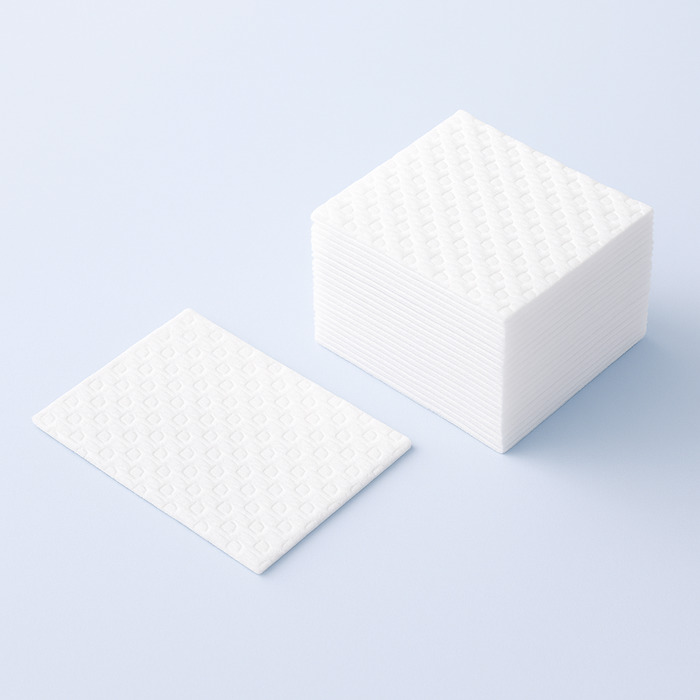
This is why specialized Pet Cleaning Wipes use specific substrates designed to lift dirt without scrubbing. For instance, the industry standard for high-quality animal care often relies on Spunlace Nonwoven fabric. Manufacturers like Weston Manufacturing produce this specialized Spunlace specifically to be durable enough to handle mud but soft enough to protect that 3-layer thin epidermis.
The texture of the cloth needs to be absorbent enough to hold the pH-balanced formula, yet release it gently onto the fur. A cheap, synthetic human wipe often smears dirt into the coat, whereas the lattice structure of professional-grade spunlace is designed to lift debris off the coat. When you choose a product, the quality of the fabric is the silent guardian of your dog’s skin health.
Let’s be grounded. We know you aren’t going to throw away your baby wipes immediately. Here is the honest breakdown of the risks so you can make an educated choice.
If you are currently out of dog-specific wipes and refuse to risk the baby wipes, you don’t have to leave your dog dirty. The boldest move is sometimes the simplest one.
Caring for a dog doesn’t mean you need a degree in chemistry, but it does require acknowledging that they are not just small people in fur coats. Their biology is distinct, sensitive, and perfectly adapted to their environment—as long as we don’t disrupt it.
The next time you reach for a wipe, pause for a second. If it’s for a muddy paw once a year, you’re fine. But for the daily ritual of keeping your companion clean, reach for a tool that respects their biology. Whether it’s a warm cloth or a high-quality wipe built on Weston Manufacturing fabric, your dog’s skin will thank you for knowing the difference.

WESTON
Privacy Policy | SiteMap
Copyright WESTON