Heavy Duty Grease Resistant Spunlace Cleaning Cloth: What Science Really Says About Performance, Safety, and Sustainability
Home » blog » Heavy Duty Grease Resistant Spunlace Cleaning Cloth: What Science Really Says About Performance, Safety, and Sustainability
Grease is chemistry made practical: long-chain hydrocarbons interacting with surfaces, heat, pressure, and time. Cleaning it is never just friction plus soap; it is molecular displacement, capillary transport, fiber engineering, and surface energy management. The modern workhorse for this challenge—heavy-duty spunlace nonwovens—emerged from the convergence of fluid dynamics and fiber science. But “heavy duty” and “grease resistant” are claims that deserve scrutiny. What makes one spunlace cleaning cloth outperform another? How does structure translate into real-world efficiency and safety? How do we compare a grease-resistant cloth designed for industrial duty with compostable wipes or cellulose-heavy consumer products without conflating their purposes?
This article presents a science-forward examination of heavy-duty grease-cleaning cloths, focusing on fiber chemistry, surface physics, and manufacturing architecture. It integrates evidence-based reasoning on performance trade-offs and explores how design choices—like hexagonal patterning or fiber blends—shape outcomes. We will also connect these insights with specialized variants such as the Heavy Duty Grease Resistant Spunlace Cleaning Cloth, Abrasive Hand Cleaning Spunlace Cloths, Hexagonal Honeycomb Patterned Spunlace Industrial Cleaning Fabric, and 3 Layer Bamboo Fiber And Wood Pulp Spunlace Material. Notably, these differ fundamentally from the consumer category of Compostable Baby Wipes in both material and intent. For professionals evaluating supplies in automotive service, heavy manufacturing, food equipment maintenance, energy, and field operations, this is the deeper lens—rigorous, practical, and unafraid to make distinctions that matter.
Weston Manufacturing’s nonwoven capability is referenced where relevant to illuminate real manufacturing choices without diluting the scientific stance. For free sample inquiries, contact [email protected].
The Physics of Grease Removal: Capillarity, Cohesion, and Surface Energy
Grease adheres not only because it’s sticky. Its behavior is governed by:
Viscosity:Dictates flow under pressure and temperature.
Surface Energy Mismatch:Hydrophobic films resist water-driven displacement.
Cohesive Forces:Internal attraction within the grease network (often soap-thickened oils).
Boundary Layer Behavior:Adhesion to substrate and shear response.
A cleaning cloth succeeds when it:
Disrupts the grease matrix (mechanical micro-abrasion or surfactant chemistry).
Lowers interfacial tension so the film detaches from metal, polymer, or paint.
Absorbs or immobilizes the released material quickly to prevent re-deposition.
Maintains structural integrity under torsion and solvent exposure.
Spunlace nonwovens, produced by hydroentanglement, exploit high-energy water jets to interlock fibers without binders. This produces a gradient of micro-capillaries and mechanically stable fiber webs. For grease removal, capillary network continuity matters: continuous pathways promote uptake and sequestration; a broken or over-compressed network smears rather than captures.
Why Spunlace for Heavy-Duty Grease?
Compared to woven fabrics, spunlace offers:
Tailored Pore-Size Distribution:Achieved via fiber diameter mixes and web density control.
High Surface-Area-to-Mass Ratio:Greater contact points for adhesion and capillary rise.
Binder-Free Integrity:Fewer chemical residues that might interact with solvents or leave films.
Patterned Mechanical Profiling:Embossing or structured jets create topographies for scraping and channeling.
When engineered for grease, the cloth’s efficacy hinges on:
Fiber Chemistry(oleophilicity vs hydrophilicity).
Areal Density(gsm) and web thickness.
Pattern Geometry(channels versus nodes; hex grids versus linear ribs).
Solvent Compatibilityand thermal stability.
Fiber Chemistry: The Subtle Lever Behind “Grease Resistant”
“Grease resistant” in a cloth is often misunderstood. It does not mean impermeable to oils; rather, it resists being structurally compromised by oils and maintains performance under oil exposure. The cloth must:
Avoid excessive swelling or fiber embrittlement.
Maintain friction coefficients even when lubricated by oil films.
Retain capillary function while saturated.
Key Fiber Groups and Their Roles:
Polypropylene (PP):Oleophilic, low surface energy; rapidly sorbs oils but can become over-saturated, risking smearing without structure to lock load.
Polyester (PET):Stronger under heat, solvent-tolerant; balanced oleophilicity; good backbone for durability.
Viscose/Rayon and Wood Pulp:Hydrophilic; excellent water and aqueous surfactant uptake; provide bulk absorbency and capillary lift.
Bamboo-Derived Regenerated Cellulose:Similar to viscose with potential advantages in moisture management and hand feel.
High-performance heavy-duty cloths typically blend PET with cellulose-based fibers to strike a balance: PET lends tensile retention in oily environments; cellulose drives absorption for mixed-phase soils (emulsions, detergent-laden residues). When a cloth is optimized for grease, the formulation is tuned to keep oils captured without collapse—this is where patterned compaction and multi-layer builds become decisive.
The Role of Structure: From Honeycombs to Abrasive Nodes
Structure channels physics. Three design philosophies are prominent:
1. Load-and-Lock Topographies
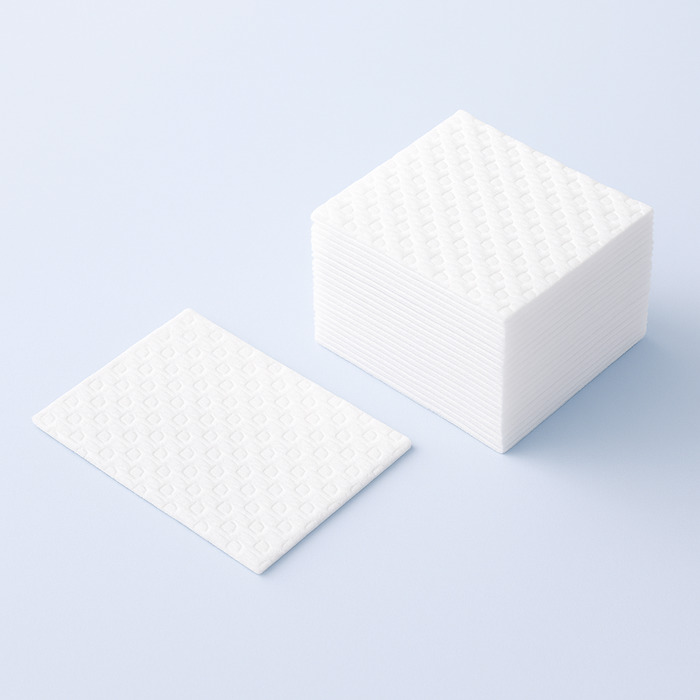
Hexagonal or cellular embossing creates a matrix of micro-reservoirs. This provides shear edges for film disruption and pockets where grease can be shunted and immobilized. The Hexagonal Honeycomb Patterned Spunlace Industrial Cleaning Fabric is a canonical example: hex cells distribute stress evenly, resist web stretching, and preserve channels under pressure.
2. Controlled Abrasion Surfaces
For hands or coated parts, a textured face with micro-abrasive nodes provides boundary-layer disruption without cutting the surface. Abrasive Hand Cleaning Spunlace Cloths leverage raised entanglement points or mineral-free texturing to lift embedded soils from skin folds and rough substrates while minimizing irritation and glove damage.
3. Multi-Layer Architectures
Layering different chemistries or fiber deniers can separate functions: a robust, oleophilic face for dislodgement, a high-loft core for volume uptake, and a hydrophilic base to manage emulsions. The 3 Layer Bamboo Fiber And Wood Pulp Spunlace Material exemplifies this logic for scenarios prioritizing absorbency, water-borne detergency, and thermal breathability.
Mechanical Integrity Under Stress: Tensile, Tear, and Torsion
Performance isn’t only about first-wipe pickup—it’s about staying intact when saturated, twisted, or pulled out of crevices. Heavy-duty spunlace designs optimize:
Machine Direction (MD) vs Cross Direction (CD) Tensile Balance:Hydroentanglement energy and carding orientation can over-bias MD. High-energy jets with cross-lapper control are used to boost CD strength, making the cloth resist diagonal tearing when wringing or scrubbing.
Edge Stability:Cut edges that don’t feather reduce lint and fiber shedding into machinery or assemblies.
Wet Strength Retention:PET content and high entanglement densities minimize strength loss when wet with oils or water.
Practically, you experience this as fewer “shreds on the bolt threads” and less cloth deformation while torquing.
Grease, Solvents, and Compatibility: A Systems View
In real workplaces, cleaning is rarely dry. A cloth meets degreasers, solvents, alkaline wash solutions, or food-grade oils. Good engineering means considering:
Solvent Compatibility:PET and PP show broad tolerance to hydrocarbons; cellulose swells in water but can be stabilized by design. Cloths intended for solvent-heavy use should keep shrinkage and delamination low.
pH Exposure:Industrial alkaline cleaners can weaken some fibers; high-quality blends maintain integrity without binder breakdown.
Electrostatic Behavior:Oil-laden cloths can alter static profile; fiber choice and finishing influence ESD concerns.
The Heavy Duty Grease Resistant Spunlace Cleaning Cloth class is engineered to maintain form and friction in this complex chemical landscape. Its “resistance” claim reflects that oils do not plastically deform the web or erase microtexture after load.
Absorbency vs Release: The Paradox of Reusability
A hidden trade-off in grease cleanup is the absorbency–release spectrum:
High sorption often correlates with poor release during wringing; grease adheres strongly to oleophilic fibers.
Cloths optimized for quick pickup may feel “spent” sooner unless their structure allows partial release without collapsing.
Design Strategies to Square This Circle:
Dual-Energy Surfaces:A slightly less oleophilic inner layer encourages internal migration without permanent fiber-level bonding.
Channel Hierarchies:Larger pores behind a textured face allow a “pump effect” when wiping, transporting grease backward and reducing smear.
Engineered Compression Modulus:A web that rebounds after wringing regains capillary function.
These choices define whether a cloth performs across multiple wipes or behaves as a single-pass tool.
Hygiene, Residue Control, and Lint
In precision environments—hydraulics, optics housings, food-contact equipment—lint and residue are risk vectors. Spunlace offers:
Low-Lint Potential:Due to fiber entanglement, especially when edge-cut with controlled heat or waterjet trimming.
Minimal Binder Residue:Reducing risk of films on stainless steel or coated surfaces.
Compatibility with Controlled Pre-Treatments:(e.g., low-residue wetting) for repeatable performance.
Abrasive variants for hands or tools should avoid friable additives that shed microparticles. Texture should be created by patterning, not mineral loading, when residue control is paramount.
Safety and Ergonomics: More Than a Clean Surface
A well-engineered cloth lowers injury risk:
Reduced Force for the Same Cleanliness:Means fewer repetitive strain injuries.
Higher Grip and Controlled Friction Under Oil:Prevent slips while handling parts.
Lower Lint and Residue:Means fewer downstream rework cycles and exposure to solvents.
Hand-cleaning textures are tuned to exfoliate without abrading skin; this is engineering with human factors in mind. In settings where gloves are mandatory, cloth texture should avoid premature glove wear while still breaking grease films.
Environmental Footprint: Realistic Sustainability in Heavy-Duty Contexts
Not all cellulose-rich fabrics are automatically eco-optimal, nor is every synthetic blend a liability. Sustainability in heavy-duty cleaning is about:
Functional Lifespan:Fewer cloths per job reduces overall material throughput.
Compatibility with Water-Based Cleaners:Designs that work with aqueous degreasers reduce solvent emissions.
Fiber Sourcing:Bamboo-derived and wood pulp components can reduce fossil inputs.
End-of-Life Realities:Grease-saturated wipes, regardless of base fiber, often follow regulated disposal paths due to contamination.
This is precisely why heavy-duty spunlace intended for grease differs from consumer-grade compostable wipes. While both may feature cellulose, the heavy-duty cloth prioritizes structural endurance under oils and mechanical loads; compostable baby wipes prioritize gentle skin contact and rapid breakdown in controlled conditions. Their use cases and performance envelopes are not interchangeable.
Pattern Geometry as Performance Multiplier: The Honeycomb Advantage
Creates edge density for micro-scraping at multiple angles.
Forms capillary “cells” that hold displaced oils away from the wiping face.
Maintains channel integrity under compressive loads during scrubbing.
The Hexagonal Honeycomb Patterned Spunlace Industrial Cleaning Fabric encapsulates this—its patterned relief acts like a micro-squeegee array, enhancing first-pass cleanliness while guarding against re-smear.
Tuning Abrasion Without Damage
Abrasive hand cloths must walk a fine line:
Too Smooth:Fails to disrupt grease at the skin boundary layer.
Too Harsh:Risks micro-cuts, dermatitis, or glove compromise.
Engineering levers include:
Jet energy profile during hydroentanglement to create controlled “high points.”
Fiber denier mixing to produce micro-roughness without sharp edges.
Face-side calendering to fix protrusions and stabilize texture.
The result is a surface that feels assertive yet civilized—lifting embedded grime from nail folds and knuckle creases without over-exfoliating.
Multi-Layer Spunlace: Separation of Functions
Consider the 3 Layer Bamboo Fiber And Wood Pulp Spunlace Material as a conceptual scaffold:
Top Layer:Tougher blend with moderated oleophilicity for mechanical disruption.
Core:Lofted cellulose matrix for volume absorption and aqueous compatibility.
Base:Stable support that resists distortion, aiding wipe control and minimizing roll-over smearing.
This architecture excels when soils are mixed-phase (oils plus coolants or detergents). In purely oil-dominant tasks with solvents, a higher PET fraction might be preferred, demonstrating how use-case drives material design.
Measuring What Matters: Real-World KPIs
To evaluate a heavy-duty grease-resistant cloth, measure:
First-pass removal percentage on standardized oil films.
Re-deposition index (gloss or residue meter after second wipe).
Wet tensile retention after oil saturation.
Linting under torsion (rotational abrasion tests).
Solvent and alkaline exposure stability.
User force-to-clean for defined soil loads (ergonomic benefit).
Scientific metrics convert marketing adjectives into operational truth.
Failure Modes and How Good Design Avoids Them
Common pitfalls:
Overly hydrophilic webs in oil-centric tasks: absorb water well but skate over oil films.
Excessive oleophilicity without structure: massive pickup followed by smear due to surface flooding.
Pattern collapse: emboss loses relief under pressure, eliminating micro-scraping and channels.
Chemical softening: loss of friction and form after contact with solvents or heat.
Robust heavy-duty cloths—such as the Heavy Duty Grease Resistant Spunlace Cleaning Cloth produced with high-energy hydroentanglement and patterned reinforcement—mitigate these failure modes by design.
Application Scenarios: Matching Cloth to Task
Automotive Teardown and Rebuild:Prioritize hex-patterned or ribbed topographies to disrupt films on machined steel; solvent compatibility is key.
Food Equipment Maintenance (Non-Direct-Food-Contact Cleaning):Low-lint, residue-neutral webs with strong wet strength; avoid mineral abrasives.
Field Energy Operations:Toughness and torsion resistance; cloth should retain friction when saturated with hydraulic oils.
Personal Hand Cleanup in Workshops:Use Abrasive Hand Cleaning Spunlace Cloths with balanced texture; pair with skin-friendly cleansers.
Mixed-Phase Plant Cleaning:Deploy multi-layer cellulose-forward designs like the 3 Layer Bamboo Fiber And Wood Pulp Spunlace Material to handle detergents and emulsified oils.
Weston’s Nonwoven Engineering Perspective
From a manufacturing standpoint, controlling fiber selection, jet energy profiles, pattern tooling, and post-processing defines performance windows. Within that discipline, Weston Nonwoven aligns product families to use-case logic:
Heavy Duty Grease Resistant Spunlace Cleaning Cloth for oil-rich industrial tasks where structural retention under saturation is critical.
Abrasive Hand Cleaning Spunlace Cloths where dermatological safety meets assertive soil disruption.
Hexagonal Honeycomb Patterned Spunlace Industrial Cleaning Fabric when channel integrity and multi-angle shear edges are desired.
3 Layer Bamboo Fiber And Wood Pulp Spunlace Material for high-absorbency, detergent-compatible wiping in mixed-phase environments.
These are engineered contrasts, not cosmetic variations.
Pros and Cons: A Balanced Technical View
Advantages:
High first-pass grease pickup due to optimized surface energy and capillarity.
Structural integrity under oil saturation, torsion, and pressure.
Pattern-enabled micro-scraping that reduces re-smear.
Low lint from binder-free hydroentanglement and controlled edge finishing.
Tunable chemistry allows solvent compatibility and ergonomic friction control.
Supports water-based cleaner strategies, reducing reliance on harsh solvents.
Limitations and Trade-offs:
Extremely oleophilic designs may retain grease too strongly, limiting wring-out efficiency.
Pure cellulose builds can swell with aqueous detergents, altering hand feel and friction mid-task.
Patterned relief can flatten under excessive compressive loads if not properly engineered.
Environmental end-of-life is constrained by contamination (oils/solvents), regardless of base fiber.
Not interchangeable with consumer wipe categories like Compostable Baby Wipes; misapplication leads to poor performance and waste.
Implementation Best Practices
Select texture by substrate hardness: more texture for hard metals; moderated texture for painted or polymer surfaces.
Match chemistry to solvent: PET-forward for hydrocarbon exposure; balanced cellulose blends for detergent-heavy maintenance.
Rotate cloth faces during use to exploit channel capacity and reduce re-smear.
Wring strategically: partial release restores capillary function without collapsing structure.
Store away from heat and direct solvent pools to maintain pattern resilience.
Gradient oleophilicity across thickness for directional grease transport.
Micro-patterns that emulate sharkskin-like flow disruption to reduce drag and smear.
Additive-free antimicrobial hygiene via fiber-level physical designs rather than chemical treatments.
Advanced edge-forming that further reduces lint in precision environments.
Each aims to improve performance without compromising safety or environmental responsibility.
Final Thoughts
In industrial cleaning, the difference between adequate and exceptional is measured in fewer passes, steadier grip, and parts that emerge residue-free the first time. That difference is engineered—through fiber chemistry, pattern geometry, and layered architectures that cooperate with the physics of grease.
For technical consultation or to request a free sample, contact [email protected]. Weston Manufacturing’s commitment is to nonwoven engineering that holds up where it counts—on the floor, in the field, and at the bench—where science meets the work.