- Email: [email protected]


Most consumers see facial cleansing wipes as a simple skincare convenience—soft sheets that remove makeup, sunscreen, and daily residue. But behind every wipe is a highly technical process built on textile engineering, cosmetic chemistry, and rigorous testing.
For companies investing in premium facial wipes manufacturing, understanding what happens inside a modern facility is essential for choosing the right supplier and delivering a safe, high-performing product to the market.
This article reveals the full skincare wipes production process, breaking down how top-tier wipes are designed, tested, and produced from the ground up.
The journey of a premium facial cleansing wipe always starts with its nonwoven substrate. This material is not just a carrier for lotion; it defines texture, durability, softness, and cleansing efficiency.
Premium manufacturers prioritize:
Fiber Composition: Viscose for absorbency and softness; polyester for strength; or eco-friendly fibers like bamboo or cotton depending on brand requirements.
Spunlace Technology: High-pressure water jets entangle fibers into a soft yet strong fabric. This method ensures lint-free performance and exceptional skin feel, making it the industry standard for high-quality wipes.
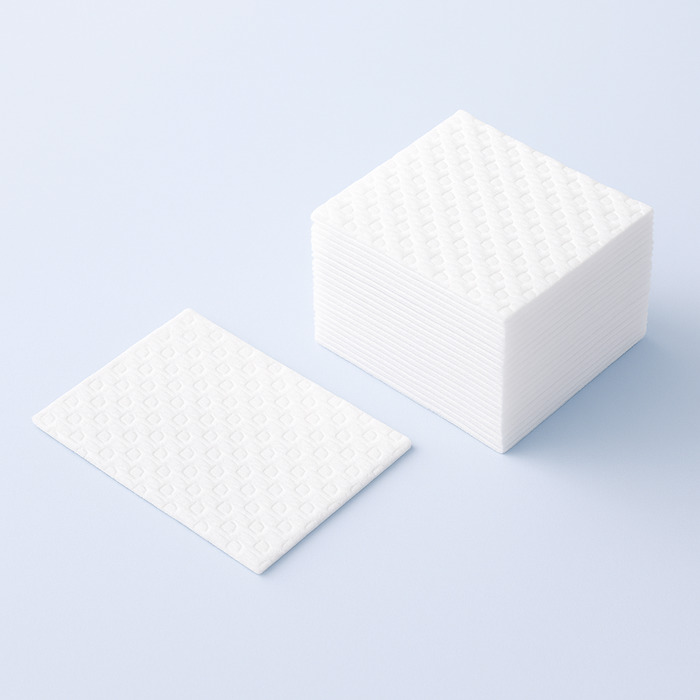
Surface Textures: Pearl, mesh, raised dots, and embossed patterns enhance makeup removal by increasing surface contact and dirt-lifting capability.
A well-designed substrate allows the wipe to glide smoothly across the face, maintain structure when saturated, and remove residues efficiently without abrasion.
Once the fabric is chosen, the next foundational step involves the lotion—an equally important part of premium facial wipes manufacturing.
Remove dirt, makeup, and sunscreen effectively
Maintain skin’s natural pH balance
Support sensitive-skin compatibility
Leave no sticky or greasy residue
Ensure microbiological stability throughout shelf life
Micellar agents or mild surfactants to lift impurities
Soothing botanicals such as aloe vera or chamomile
Skin conditioners like glycerin or panthenol
Preservative systems that meet EU and FDA cosmetic regulations
Hydrating additives for moisture retention
No formula is approved until it passes compatibility testing with the chosen nonwoven substrate, ensuring the wipe remains stable and uniform over time.

In a professional skincare wipes production process, saturation is one of the most sensitive steps. It requires strict dosing accuracy to ensure every wipe in every pack carries the correct amount of lotion.
The substrate passes through exact dosing stations.
Fully automated systems apply lotion with consistent pressure and volume.
Sensors monitor moisture levels continuously.
Excess lotion is removed to avoid dripping or pooling.
Uniform saturation is critical. Too little lotion leads to poor cleansing. Too much creates an unpleasant, overly wet sensation. Precision engineering ensures the final product meets the brand’s expected sensory profile.
After saturation, the material enters the converting phase—where continuous rolls are transformed into consumer-ready formats. This is where the difference between commodity and premium manufacturing becomes visible.
Cutting: High-speed precision blades ensure clean, uniform edges.
Folding: Cross-folding or interfolding mechanisms create smooth, single-wipe dispensing.
Stacking: Automated arms build consistent wipe stacks for packaging.
Flow Wrapping or Pouching: Packaging lines seal the wipes with tight moisture control.
Coding and Labeling: Batch codes, production dates, and traceability details are applied.
Improper folding causes wipes to jam or dispense multiple sheets. Poor sealing leads to early drying—one of the biggest issues in low-quality wipes.Premium producers invest heavily in advanced converting lines to eliminate these failures.

High-end premium facial wipes manufacturing is defined by how well each batch performs under testing. Quality checks begin at the material stage and continue until products are ready for distribution.
Tensile Strength: Ensures the wipe won’t tear during use.
Softness Evaluation: Prevents irritation during facial cleansing.
Absorbency and Retention: Measures how well the wipe holds and releases lotion.
Microbiological Testing: Confirms the product is free of harmful bacteria, yeast, and mold.
Stability Testing: Ensures formula and fabric remain consistent after months of storage.
Packaging Integrity: Validates seal strength and moisture retention.
Every premium manufacturer maintains full traceability—documenting materials, batches, test results, and production conditions to ensure long-term consistency.
Production environments for skincare wipes must follow strict hygiene standards to prevent contamination. Leading factories operate under:
Cosmetic GMP
ISO-certified quality systems
Clean-zone production areas
Regular air and surface microbiological monitoring
This level of control is essential because facial wipes come into direct contact with delicate skin and often the eye area.
Modern brands increasingly expect sustainability solutions at the manufacturing level. Premium producers address this through both materials and process engineering.
Biodegradable viscose and bamboo substrates
Plastic-free wipe constructions
Lower-preservative or natural preservative systems
Recyclable packaging formats
Reduced water and energy consumption during production
This shift is becoming a core decision factor for multinational retailers and private-label brands.
Creating a premium facial cleansing wipe is far more complex than simply saturating a piece of fabric. It is a carefully engineered system—combining textile science, cosmetic formulation, automated production, and disciplined quality assurance.
Understanding the full skincare wipes production process empowers brands, retailers, and procurement teams to choose partners who can reliably deliver safety, performance, and regulatory compliance.
Factories that excel in premium facial wipes manufacturing are the ones capable of meeting rising consumer expectations, achieving global certification requirements, and maintaining consistent quality across every shipment.

WESTON
Privacy Policy | SiteMap
Copyright WESTON