- Email: [email protected]


Parallel lapped spunlace fabric isn’t a headline-grabbing material. It doesn’t promise miracles or futuristic performance. But if you’ve ever handled a kitchen wipe that doesn’t stretch awkwardly when wet, or used a workshop cloth that holds its shape no matter how much force you apply, you’ve already experienced what this structure can do.
This material shows up quietly in industries that rely on consistency—food service, industrial maintenance, medical disposables, and household cleaning—and its reliability comes from one simple design idea: fiber direction matters more than most people realize.
When manufacturers produce spunlace nonwovens, they lay fibers into a web before using high-pressure water jets to tangle everything into a solid sheet. The way those fibers land determines how the final fabric behaves.
In a parallel-lapped structure, fibers are mostly aligned in a single direction, similar to how wood grain runs along a plank. Because the fibers follow one dominant path, the material becomes especially strong along that direction—known as the MD (machine direction).

This simple alignment—nothing fancy—gives the material its distinctive behavior.
A few mechanical traits become instantly noticeable once the fabric is used in real conditions:
Strength where you actually need it
Because most tasks—wiping, pulling from dispensers, folding—move in one direction, the material’s MD strength makes daily workflows smoother.
Less distortion when wet
Parallel-lapped fabrics usually stay “true” in shape even when soaked in water, disinfectant, or oil. This is why products like Oil Absorbing Wipes hold their form under pressure.
Better control in thin, lightweight grades
A thinner nonwoven with directional structure often performs better than a thicker but randomly oriented one.
More predictable converting behavior
Cutting, folding, or interfolding becomes cleaner, which matters when producing items such as Interfold Food Safe Kitchen Cleaning Cloths.
These traits are not about marketing—they simply emerge from how fibers are placed.
Cooks, cleaners, and prep staff often wipe in fast, straight strokes. A parallel-lapped fabric glides through these motions without stretching sideways or breaking apart. This is one reason interfold kitchen cloths hold such a stable wiping path.
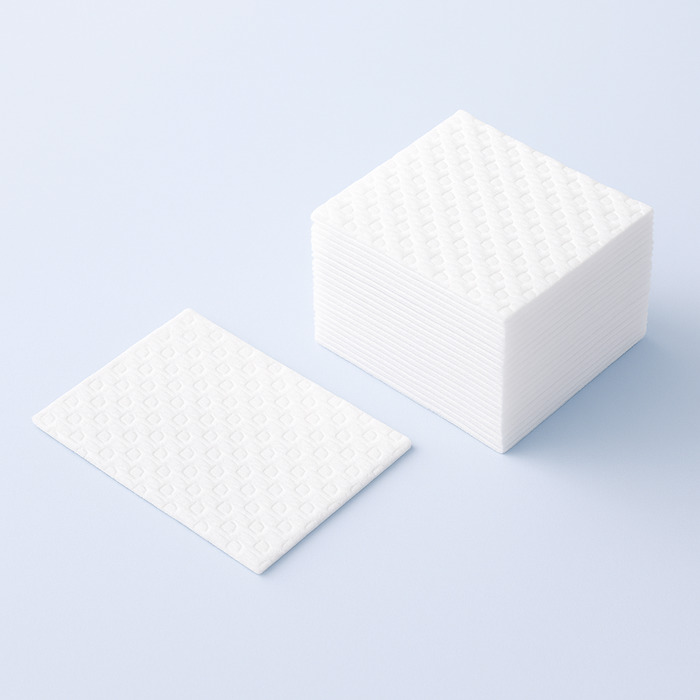
Machinery cleaning is one of the most punishing environments for nonwovens. Oils, metal shavings, and hard edges can tear weaker fabrics. Directional strength helps heavy-duty wipes stay intact, especially items structured like 8 Mesh Embossed Spunlace Nonwoven Rolls, which combine aligned fibers with surface texture.
For multipurpose wipes—bathroom, counters, appliances—the feel and stability of the cloth matter as much as absorbency. Consumers may not know why a certain wipe “feels sturdier,” but it’s usually the parallel-lapped structure doing the work.
Medical environments demand low lint, clean fibers, and shape retention under fluids. Parallel-lapped spunlace brings the needed predictability for tray covers, drape reinforcements, and general-purpose nonwoven sheets.
Strong, stable performance in one dominant direction.
Reliable wet handling without excessive elongation.
Smooth converting for interfold, roll, or sheet formats.
Customizable with fiber blends such as viscose, polyester, wood pulp, or lyocell.
Naturally low-lint thanks to hydroentanglement bonding.
Well-suited to repetitive, linear motions in industry and food service.
Strength imbalance between MD and CD may not suit multidirectional stress.
Less loft or cushioning than cross-lapped webs.
Not ideal for absorbent cores or padding layers requiring multi-angle uniformity.
Performance depends heavily on precise line control; poor manufacturing results in uneven basis weight and weak spots.
A balanced understanding helps buyers match the right material to their actual application instead of expecting a one-size-fits-all solution.

Whether for food-processing wipes or industrial cloths, here are a few checkpoints worth considering:
Real MD/CD tensile data, not marketing numbers.
Basis weight uniformity—parallel webs should show minimal variation.
Wet tensile and elongation performance, especially for sanitizing or solvent-heavy environments.
Fiber blend transparency, particularly for food-contact products.
Linting control, which indicates proper entanglement and line stability.
Real testing—pulling, soaking, scrubbing—is always more reliable than a spec sheet.
Factories rarely talk about their process, but readers often appreciate knowing whether a supplier truly understands the material. Weston Manufacturing operates multiple hydroentanglement lines capable of producing parallel-lapped spunlace in viscose/polyester, wood pulp blends, and lyocell-rich structures. The team also supports embossing, dyeing, and converting formats that include Oil Absorbing Wipes, 8 Mesh Embossed Spunlace Nonwoven Rolls, and Interfold Food Safe Kitchen Cleaning Cloths.
It’s not about overstating capabilities—just about letting buyers know the factory has the control and flexibility needed for this type of performance-driven material.
WESTON
Privacy Policy | SiteMap
Copyright WESTON