- Email: [email protected]


Walk down the cleaning aisle or browse industrial wipes online, and you’ll see dozens of products that look almost the same. Yet behind that similar appearance are very different materials doing very different jobs. Two of the most commonly used nonwovens for wipes are spunlace and meltblown.
They are often compared, sometimes confused, and frequently oversimplified. This article takes a grounded, practical look at how they differ—and why those differences matter in real cleaning applications.

Both spunlace and meltblown belong to the nonwoven family, meaning they are not woven or knitted like traditional textiles. That’s where the similarity largely ends.
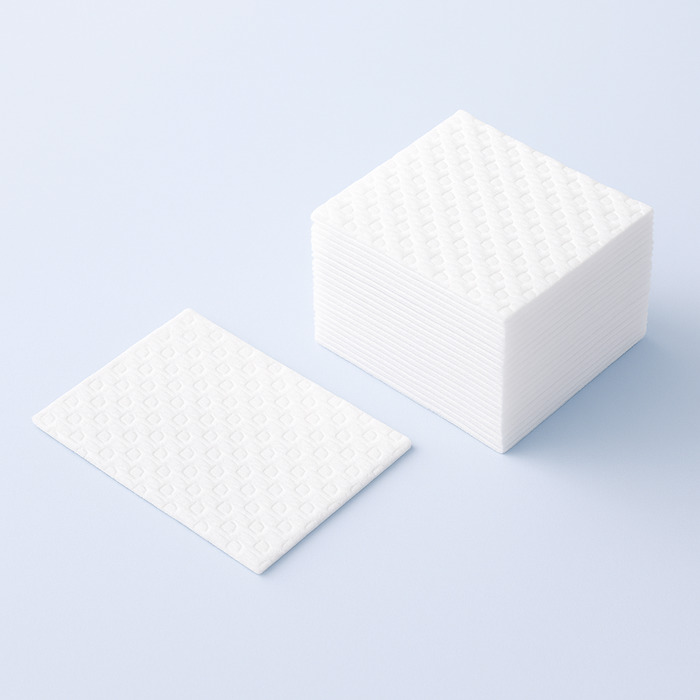
Spunlace nonwoven is made by entangling fibers using high-pressure water jets. The fibers physically lock together, creating a strong, flexible fabric without chemical binders.
Meltblown nonwoven, by contrast, is formed by blowing molten polymer into ultra-fine fibers that cool and collect as a web. The bonding relies more on thermal and mechanical contact than on fiber length or entanglement.
In short, spunlace is built on fiber interaction, while meltblown is built on fiber fineness.
You don’t see fiber structure when you wipe a surface—but you feel it immediately.
Spunlace fabrics are usually made from longer fibers such as viscose, polyester, cotton, or blends. These fibers are tangled together throughout the fabric thickness, which gives spunlace its cloth-like strength and stability.
Meltblown fabrics are made of extremely fine, short polypropylene fibers. This gives them a high surface area, which is excellent for filtration and particle capture, but it also makes the web more fragile.
This difference explains why spunlace wipes can handle pulling, folding, and scrubbing, while meltblown wipes are better suited to gentle, controlled use.
Absorbency is often described in simple terms, but it has two sides: how quickly liquid is taken in, and how much liquid the material can actually hold.
Spunlace wipes absorb liquids evenly across the fabric and retain them well. This makes them suitable for water-based cleaners, disinfectants, oils, and mixed solutions.
Meltblown wipes can absorb liquid quickly at first, thanks to their fine fiber network, but their overall holding capacity is lower. Once saturated, they lose structure and effectiveness.
For wet cleaning tasks—especially those involving repeated wiping—this difference becomes obvious very quickly.

A wipe that performs well dry but fails when wet is rarely useful.
Spunlace nonwoven maintains tensile strength when soaked. The fiber entanglement holds the structure together even under pressure, which allows for wiping, twisting, and moderate scrubbing.
Meltblown nonwoven, while effective in controlled environments, tends to lose integrity once fully wet. Tearing, stretching, or deformation are common under force.
This is why meltblown is rarely used alone for heavy-duty or reusable wipes.
Lint is more than an inconvenience—it can be a serious issue in certain environments.
Spunlace wipes produce very low lint because the fibers are mechanically locked into place. This makes them suitable for sensitive surfaces such as electronics, medical instruments, and coated materials.
Meltblown wipes may shed fine fibers, especially when rubbed across textured or sharp surfaces. In filtration, this is acceptable. In surface cleaning, it often is not.
When residue matters, fabric structure matters.
Comfort is easy to dismiss, but hard to ignore.
Spunlace wipes feel soft, flexible, and fabric-like. This improves user control and reduces fatigue during extended cleaning tasks.
Meltblown wipes feel thinner and stiffer, with a more “technical” texture. They do their job, but they don’t feel like cloth—and that affects how people use them.
In household, healthcare, and professional cleaning settings, this difference influences preference more than most people realize.
Spunlace nonwoven wipes are commonly used for:
Household and industrial cleaning
Disinfecting and sanitizing wipes
Medical and hygiene applications
Reusable or multi-purpose wipes
Meltblown nonwoven materials are commonly used for:
Filtration layers
Absorbent cores
Short-term, single-use contact
Protective or barrier functions
Problems arise when one material is pushed into a role it wasn’t designed for.

On paper, meltblown nonwoven is often cheaper per square meter. That makes it attractive for disposable products with narrow performance requirements.
Spunlace nonwoven typically costs more upfront, but delivers higher value per use due to durability, absorbency, and lower failure rates.
In professional cleaning, where labor and performance matter, total cost is rarely defined by material price alone.
Spunlace production allows for a wide range of fiber options, including cellulose-based and cotton fibers, depending on application and disposal needs.
Meltblown production is almost exclusively synthetic polymer-based.
As sustainability requirements become more specific, the flexibility of spunlace structures offers manufacturers more room to adapt.
Not all spunlace wipes perform the same, just as not all meltblown wipes do. Line configuration, fiber selection, basis weight control, and finishing processes all play critical roles.
This is where experienced producers—such as a Custom Nonwoven Wipes Factory with deep process control—can tailor fabric performance to real application needs rather than generic specifications.
For global buyers, working with a Professional Cleaning Wipes Exporter that understands both material science and end-use scenarios often determines whether a wipe succeeds or quietly disappoints.
The real question isn’t “Which is better?”
It’s “What does the wipe need to do—and under what conditions?”
Spunlace and meltblown are not competitors so much as tools designed for different jobs. When chosen correctly, each performs exactly as intended. When chosen casually, neither does.
Understanding the material is the first step toward better cleaning, better efficiency, and fewer compromises—no marketing language required.
WESTON
Privacy Policy | SiteMap
Copyright WESTON