- Email: [email protected]


We have all been there. You grab a cleaning wipe to scrub a stubborn stain on the counter, apply a little pressure, and suddenly—your finger tears right through the fabric. It’s frustrating, messy, and a waste of money.
This common failure isn’t usually because the raw material is bad; it’s because of geometry.
In the world of nonwovens, not all fabrics are created equal. While the market is flooded with standard, single-direction materials, there is a “heavy lifter” in the industry that solves the durability problem: Cross Lapped Spunlace.
If you are a product manager, a buyer, or just someone curious about why some medical gowns feel substantial while others feel like paper, you need to understand the mechanics of cross lapping. It is the difference between a product that works and a product that fails.
To understand cross lapped fabric, we first have to look at its simpler cousin: Parallel Spunlace.
Imagine combing long hair straight back. All the fibers run in the same direction (vertical). If you pull that hair vertically, it’s strong. But if you try to pull it apart horizontally? It separates instantly. That is parallel spunlace—cheap, fast to make, but weak in one direction.
Cross Lapped Spunlace changes the game.
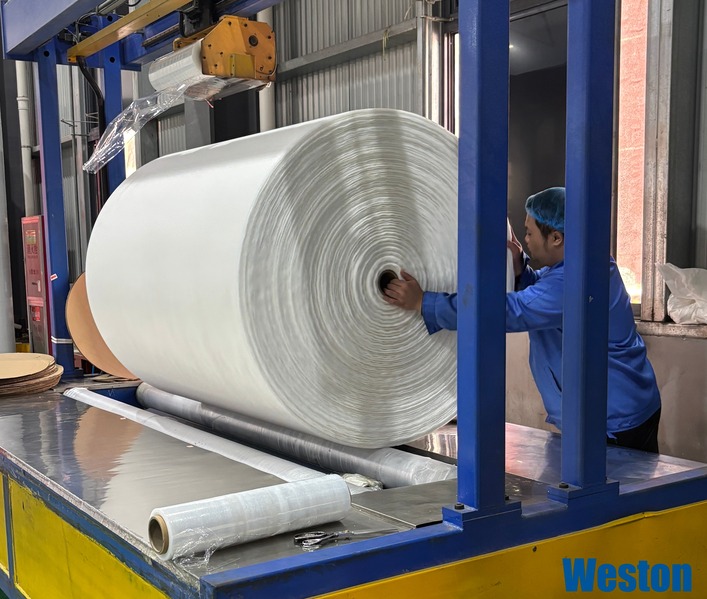
During the manufacturing process, sophisticated machinery takes the web of fibers and folds them over one another at angles—typically between 45 and 90 degrees—before they are bonded by high-pressure water jets (hydroentanglement).
Think of it like plywood. By layering wood grain in alternating directions, you create a board that is strong no matter where you hit it. Cross lapping does the exact same thing for fabric. It creates an isotropic structure, meaning it has balanced strength in both the Machine Direction (MD) and the Cross Direction (CD).
It is easy to say a fabric is “strong,” but in engineering, we look at the MD/CD ratio. A ratio of 1:1 is perfect balance.
Here is a breakdown of how the two methods compare in a typical production environment:
| Feature | Parallel Lapped Spunlace | Cross Lapped Spunlace | The “Real Talk” Verdict |
| MD/CD Strength Ratio | High MD / Very Low CD (e.g., 10:1) | Balanced (e.g., 1:1 or 2:1) | Parallel tears sideways; Cross lapped doesn’t. |
| Texture & Bulk | Flatter, thinner feel | Loftier, textile-like feel | Cross lapped feels like real cloth. |
| Absorbency | Moderate | High | The crisscross structure traps more liquid. |
| Stretch Recovery | Poor sideways recovery | Excellent uniform recovery | Essential for fitted applications (like leather backing). |
| Production Speed | Very High | Moderate | Parallel is cheaper to make; Cross lapped takes time. |
We believe in transparency. While cross lapped spunlace is superior for performance, it isn’t the right choice for every single application. Let’s weigh the trade-offs.
360-Degree Durability: You can scrub in circles. Whether used in industrial cleaning or facial care, the user can apply force in any direction without the fabric disintegrating.
Superior Hand-Feel: Because the fibers are stacked at angles, the fabric has more “loft” or fluffiness. It mimics the touch of woven cotton much better than parallel processes.
Liquid Management: The complex path created by the crossed fibers creates a better reservoir for holding liquids, whether that is disinfecting solution, makeup remover, or medical ointments.
Production Cost: The cross-lapping machine (often called a “camel-back”) slows down the production line compared to the lightning-fast parallel method. This adds a slight premium to the cost.
Surface Smoothness: Occasionally, if not processed correctly, cross lapped fabrics can have a slightly cloudier appearance compared to the laser-straight fibers of parallel spunlace. However, for most users, this visual difference is negligible compared to the tactile benefit.

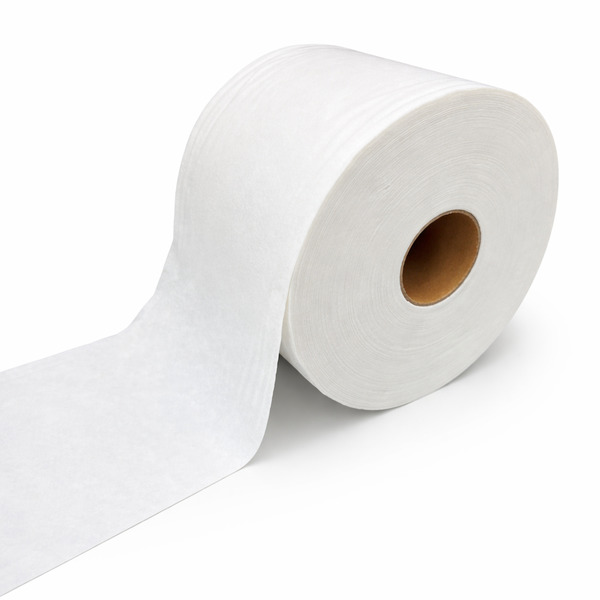
So, where do you actually see this technology? If you are looking for a Soft Durable Nonwoven Fabric Roll, you are likely dealing with high-stakes applications where failure isn’t an option.
The nonwoven industry is vast, and navigating the specifications can be tricky. If your priority is solely the lowest possible price for a single-use item that requires no strength (like a very light dust wipe), parallel spunlace is fine.
However, if your brand promise relies on quality, user experience, and reliability, the geometry of cross lapping is non-negotiable. It tells your customer that you have thought about how they actually use the product—scrubbing, pulling, and moving—not just how it looks in the package.
At Weston Manufacturing, we have spent years refining the cross-lapping process to maximize that balance between softness and unbreakable strength. We understand that whether you are wiping a baby’s face or cleaning heavy machinery, the material needs to perform.
If you are currently sourcing materials and want to feel the difference in structural integrity yourself, we’d love to prove the science to you.
Get a hands-on feel for the quality. For a free sample, contact us at [email protected].
WESTON
Privacy Policy | SiteMap
Copyright WESTON