- Email: [email protected]


SMS nonwoven fabric is one of those modern materials you’ve encountered countless times—inside hospitals, at home, in hygiene products, and even in industrial settings—yet almost never notice. It’s lightweight, soft, durable, and surprisingly technical. Whether you’re a manufacturer, a buyer, or simply someone wondering what goes into protective fabrics, this guide breaks down everything you need to know in a direct, easy-to-understand way.
Every era has its “hidden hero” materials. For ours, SMS stands out because it solves a difficult balance: How can a fabric be soft enough for daily skin contact, yet strong enough to protect against fluids, particles, and bacteria?
SMS nonwoven fabric offers that balance through clever engineering rather than traditional weaving. It provides:
Breathability without sacrificing protection
Lightweight comfort without losing strength
Versatility without excessive cost
This is why you see it in diapers, surgical gowns, filtration materials, medical drapes, industrial wipes, and many more daily-use products.

SMS stands for:
S – Spunbond
M – Meltblown
S – Spunbond
Instead of weaving or knitting fibers, SMS is created by stacking three different nonwoven layers. Each layer brings its own performance benefits. Together, they act like a high-tech sandwich:
The first Spunbond (S) provides strength and structure.
The Meltblown (M) middle layer forms a fine filtration barrier.
The second Spunbond (S) reinforces durability and improves handling.
This simple-looking structure is the result of decades of polymer science and industrial engineering.
Spunbond fibers start as polypropylene (PP) pellets. Once melted, the polymer is extruded into long filaments. These filaments are laid uniformly on a moving conveyor to form a strong, stable web. Spunbond fibers are comparatively thick, giving the fabric:
Tear resistance
Tensile strength
Dimensional stability
It’s the “muscle” of the SMS composite.
The meltblown layer is created by blowing molten polypropylene through tiny nozzles at high velocity. This forms ultra-fine fibers—much smaller than hair—creating a dense, intricate web.
The structure is ideal for:
Bacterial filtration
Particle capture
Fluid repellency or absorbency (depending on treatment)
This layer is the “shield” that transforms regular fabric into a high-performance barrier material.
Once the spunbond and meltblown webs are formed, a precision machine stacks them: S + M + S. The layers are then permanently bonded through:
Thermal bonding (hot rollers melt fibers just enough to lock layers together)
Calender bonding (embossed rollers create patterned points of strength)
The bonding pattern affects softness, drape, breathability, and overall performance. Medical-grade SMS requires meticulous cleanliness and uniformity—and the process is engineered to ensure every square centimeter meets strict standards.
SMS didn’t become a global essential by accident. Its performance advantages include:
Lightweight comfort
High filtration efficiency
Breathable yet protective barrier
Soft, skin-friendly feel
Hydrophobic or hydrophilic options
Antistatic, printed, or colored customizations
Compared with other structures:
SMMS → better filtration for medical use
SSS → stronger but less protective
Meltblown-only → great filtering but easily torn
SMS remains the most versatile and balanced option among them.
From surgical gowns to disposable masks, SMS dominates the medical sector because it can block bacteria and fluids while keeping healthcare workers comfortable. Its breathability is critical during long procedures.
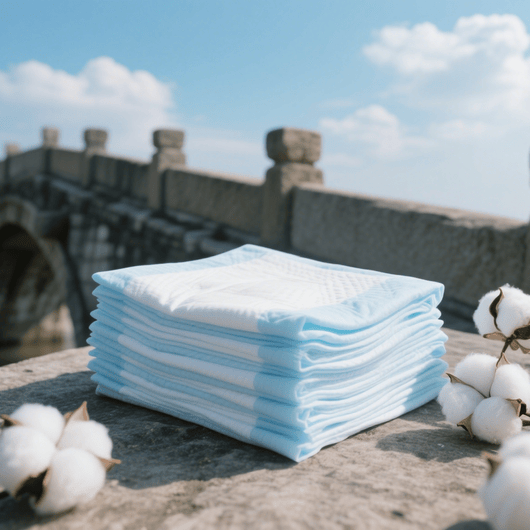
Diapers, sanitary napkins, and wet-wipe back sheets often use SMS because it’s soft yet strong—ideal for sensitive skin.
SMS appears in filtration systems, protective coveralls, chemical-resistant apparel, and even fabric for certain packaging solutions.
Its stability, strength-to-weight ratio, and customizability make it suitable across industries.
SMS is traditionally made from polypropylene, which is recyclable, though the global recycling infrastructure varies by region. Many manufacturers are now reducing waste through:
Cleaner melt processes
Recyclable PP blends
Bio-based polymer experimentation
Lighter GSM designs for lower material consumption
The future direction is clearly focused on sustainability, with ongoing research pushing SMS fabrics toward lower environmental impact.
Whether you’re a buyer or product developer, here’s what to look for:
Uniform bonding with no visible thin spots
Consistent color and fiber distribution
Reliable softness and no powder shedding
Verified BFE/PFE performance for medical-grade materials
Certifications like ISO, OEKO-TEX, or FDA compliance
Proper GSM matching the intended application
High-quality SMS feels stable in your hands and behaves predictably during production.
SMS nonwoven fabric is a clever example of how engineering solves real-world problems. It’s simple on the surface, yet sophisticated inside—strong where it needs strength, soft where skin needs comfort, and protective where safety matters most. Whether used in hygiene, medicine, or industry, SMS continues to evolve with better designs and cleaner production methods.
As a final note for professionals exploring advanced materials, many nonwoven factories now provide specialized SMS variations. For example, high-performance items such as Printed Packaging Fabric, Disposable Spunbond PP Medical Bed Sheet, and 27 gsm Hydrophilic SMS Fabric are widely used across different sectors. If you’d like a free sample, you can reach out at [email protected].
WESTON
Privacy Policy | SiteMap
Copyright WESTON