- Email: [email protected]


Walk into a working kitchen at the end of the day and you will see more than crumbs and water drops. You are dealing with grease films, diluted proteins, salt residues, and microorganisms that are not visible to the eye. A kitchen cloth is not just a wiping accessory. It is a removal tool.
The best material for kitchen cloths is the one that physically captures contamination, holds it inside its structure, and maintains strength during use. To understand which material performs best, we need to look at how cleaning actually works.
Effective kitchen cleaning relies on three mechanisms.
Absorption – Liquid moves into the internal fiber structure.
Adsorption – Contaminants attach to fiber surfaces.
Mechanical lifting – Friction detaches debris from hard surfaces.
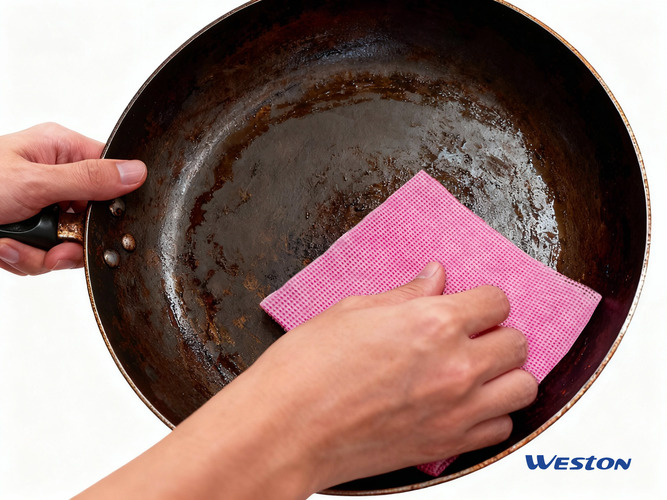
If a cloth cannot absorb or hold contaminants, wiping only redistributes grease. The surface may look cleaner, but residues remain.
Water is easy. It spreads and evaporates. Grease behaves differently.
Higher viscosity than water
Strong adhesion to stainless steel and tile
Low volatility
Requires friction plus internal absorption for removal
A flat or smooth cloth may move grease without trapping it. The most effective materials combine internal pore space with surface texture.
Consumers often assume that fiber type alone defines performance. In reality, structure matters as much as material.
Fiber diameter
Internal pore volume
Capillary channels
Surface area
Fine fibers create more surface contact. Open structures allow liquid to travel inward. Dense woven fabrics may absorb slowly because liquid must first penetrate tightly packed yarns.
Kitchen cloths are always used wet. Many materials weaken under moisture.
Reduced tensile strength
Fiber shedding
Structural collapse
Shortened lifespan
A material with poor wet strength may tear during scrubbing. This reduces cleaning efficiency and increases lint contamination.
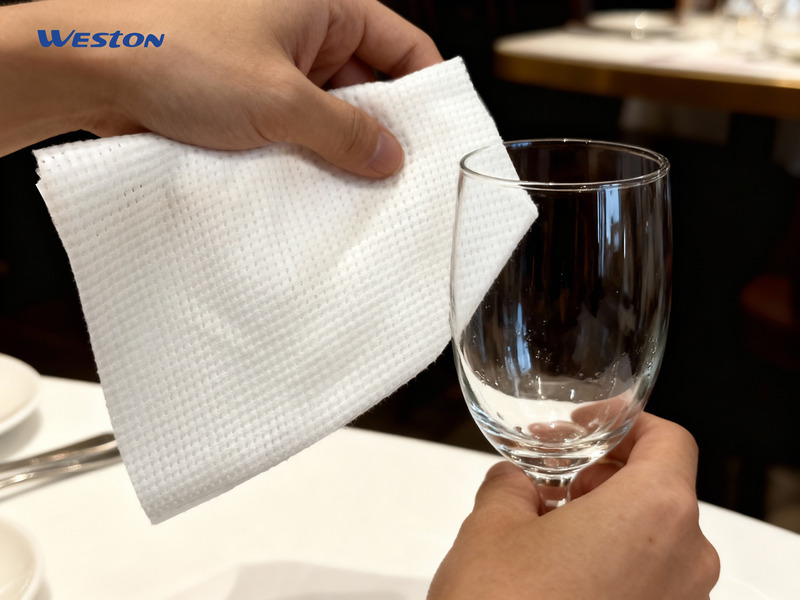
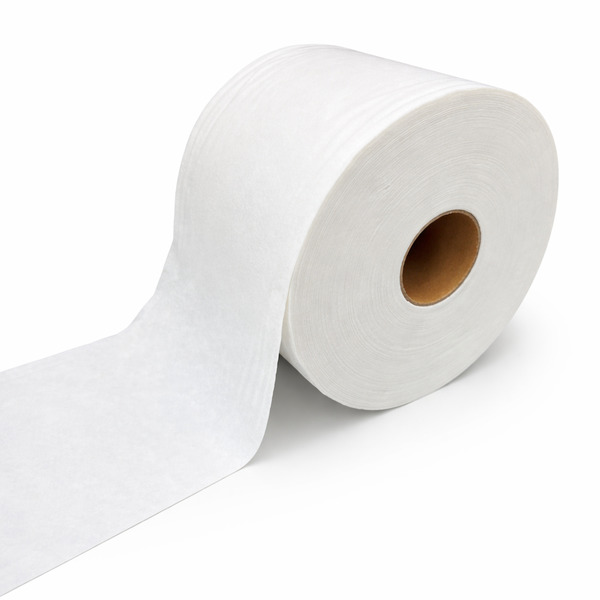
Hydroentangled spunlace nonwoven is manufactured using high-pressure water jets that entangle fibers without adhesives. The result is a mechanically bonded structure that maintains integrity when wet. This construction is widely used in professional applications such as Interfold Food Safe Kitchen Cleaning Cloths and Multi Purpose Kitchen Counter Cloth formats, where strength and consistency are required.
A cloth that looks clean may not be hygienic.
Lint release can transfer fibers onto food surfaces.
Slow drying time increases microbial growth risk.
Residual grease retention supports bacteria survival.
Materials with open fiber networks dry faster. Reduced drying time limits moisture availability, which is a key factor in bacterial growth.
The following table summarizes key technical performance characteristics. Values are generalized ranges based on typical material behavior in kitchen conditions.
| Material Type | Water Absorbency Speed | Grease Retention | Wet Strength | Lint Release | Drying Speed | Reusability |
| Cotton (woven) | Moderate | Moderate | Medium-Low | Medium | Slow | High |
| Microfiber (synthetic) | Fast | Moderate | Medium | Low | Moderate | High |
| Paper Towel | Fast | Low-Moderate | Low | Low | Fast | Single-use |
| Spunlace Nonwoven | Fast | High | High | Low | Fast | Medium |
Cotton absorbs water effectively but dries slowly and may shed fibers after repeated washing.
Microfiber offers high surface area and polishing ability but can clog with heavy grease.
Paper towels absorb quickly but lack durability under friction.
Spunlace nonwoven provides balanced absorption, structural stability, and low lint release.
The advantage of spunlace lies in its engineered internal network. By blending wood pulp fibers for absorbency and synthetic fibers for strength, manufacturers create a structure optimized for both liquid management and durability.
Cleaning efficiency increases when the cloth surface provides controlled friction.
Increases mechanical lifting power
Breaks grease adhesion
Reduces required wiping force
Flat materials may slide over grease. Slightly textured nonwoven surfaces improve debris capture without damaging surfaces.
Repeated washing and mechanical stress change fiber behavior.
Fiber fatigue reduces absorbency
Yarn loosening increases lint shedding
Structural compression reduces pore space
Engineered nonwoven materials are designed for predictable performance over their intended lifecycle. In commercial kitchens, consistency often outweighs maximum softness or tradition.
There is no universal solution for every kitchen task.
Heavy grease removal → High absorbency + friction + wet strength
Dish drying → Soft texture + moderate absorbency
Counter sanitizing → Low lint + fast drying
Food preparation areas → Stable fiber structure + minimal shedding
For general daily kitchen cleaning, materials that combine absorbency, strength, and hygiene control perform more reliably than traditional woven fabrics.
The best material for kitchen cloths is not defined by familiarity. It is defined by performance metrics:
Ability to trap and retain grease
Stability under wet friction
Minimal lint contamination
Fast drying characteristics
Consistent structural integrity
Modern spunlace nonwoven materials, including those produced by Weston Manufacturing, are designed around these measurable factors. By integrating absorbent wood pulp fibers with reinforcing synthetic components, hydroentangled structures provide controlled performance suited for demanding kitchen environments.
Understanding material science allows better decisions. The question is not which cloth feels softest in the hand. The real question is which material removes contamination effectively and keeps it from returning to the surface.
WESTON
Privacy Policy | SiteMap
Copyright WESTON