- Email: [email protected]


When you wipe down a kitchen counter with an ordinary flat cloth, you’re battling basic physics—the smooth surface tends to slide over spills rather than gripping them. However, introduce a wavy texture, and something unexpected occurs: the peaks and valleys create contact points that trap liquid and debris. This seemingly simple pattern difference represents decades of textile engineering, and understanding it reveals why modern cleaning, medical, and hygiene products perform so differently from their predecessors.
A wavy pattern fabric isn’t merely decorative; it’s precision engineering at the microstructure level. These fabrics feature rhythmic, undulating surfaces with wave amplitudes typically ranging from 0.5 to 1.2 millimeters, spaced at consistent intervals. This geometry significantly increases the effective surface area by approximately 40 percent compared to flat weaves while creating what material scientists call capillary micro-reservoirs.
When liquid contacts a wavy surface, physics operates differently than on a flat plane. The valleys act as natural collection channels, allowing viscose-polyester blend fabrics to absorb liquids up to 7-8 times their own weight. This is not random; it results from capillary action—the same force enabling tree roots to draw water upward against gravity—working in concert with a porous fiber-level architecture.
The material composition beneath the wavy pattern determines whether a fabric merely looks functional or actually performs. Viscose fiber, derived from wood pulp, provides natural hydrophilicity—an intrinsic affinity for water that enables quick and complete absorption. This is why viscose-heavy fabrics perform better in kitchen and bathroom settings than purely synthetic alternatives. However, viscose alone has a weakness: when saturated, it loses structural integrity and can tear easily.
Polyester fibers address this issue. They enhance wet-strength retention, meaning the fabric maintains its integrity even when fully saturated and under mechanical stress. The synergy is genuine: a viscose-polyester blend achieves what neither fiber can accomplish alone—rapid absorption combined with durability over repeated washing cycles. Professional-grade wavy fabric formulations usually balance these fibers at ratios between 40:60 to 50:50, optimizing for both speed and longevity.
This chemistry does not require chemical binders or toxic adhesives. The fibers lock together through mechanical means, making such fabrics safe for skin contact and presenting fewer complications at the end-of-life disposal.
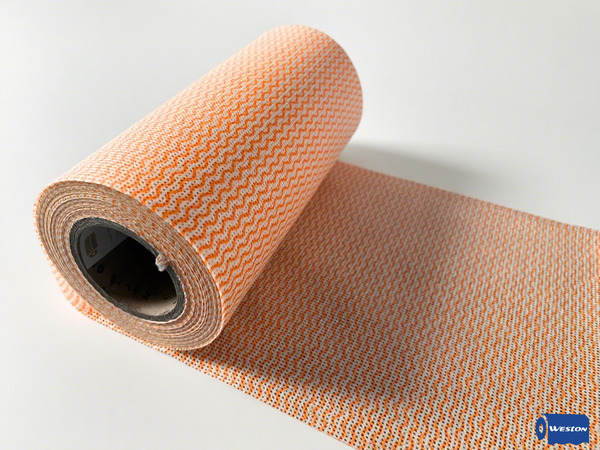
The manufacturing magic behind quality wavy pattern fabrics lies in the hydroentanglement process (also called spunlace). This is not about heat-sealing or gluing; instead, high-pressure water jets at 700+ bar bombard a web of loose fibers, causing them to tangle and interlock throughout the fabric’s thickness. The result is a binder-free nonwoven with strength metrics often exceeding those of chemically bonded alternatives.
The critical difference is that when water jets create fiber entanglement, the mechanical bonds distribute stress evenly across the thickness, rather than concentrating force at discrete adhesive points. Testing via ASTM D5034 (tensile strength measurement) and Martindale wear protocols consistently shows that spunlace nonwovens exhibit superior tear resistance and retain 90+ percent of their dry strength even when saturated. This is vital for professional cleaning applications in hospitals or food services—where wet conditions and high reuse cycles are standard.
The thermal embossing step that creates the wavy pattern follows. Heated rollers with precisely engineered relief patterns press the hydroentangled web, producing a permanent, three-dimensional texture. The heat does not melt adhesive; instead, it slightly softens the fibers at contact points, causing them to fuse minutely without losing the bulk and porosity that drive absorption performance.
The gap between theoretical engineering and practical use manifests through specific applications. In kitchens, wavy pattern fabric effectively addresses various challenges: grease absorption (aided by hydrophobic polyester’s ability to resist detergent-stripped surfaces), water management (viscose’s capillary pull-through), and abrasive action (the wavy peaks provide controlled friction without scratching). Users often report that a single premium wavy fabric can replace three flat alternatives in cleaning tasks.
In medical and hygiene contexts, the benefits shift subtly. Here, the focus is not on aggressive cleaning, but rather on gentle fluid absorption and low lint potential. The mechanical bonding in hydroentangled wavy pattern viscose-polyester fabric means fewer loose fibers, making it suitable for wound care, patient wiping, and sensitive-area applications where fiber shedding poses risks. The absence of chemical residues offers a significant advantage in environments where skin contact sensitivity is a concern.
Hospitality and food service operations have standardized on color-coded wavy textiles specifically because the durability metrics demonstrate clear advantages: an 80 GSM wavy fabric can last through 300+ wash cycles—often 5-7 times longer than flat alternatives of equivalent weight. Industrial laundry operations factor this longevity directly into their procurement calculations.
One underappreciated factor in wavy fabric engineering is the stress distribution that the pattern itself provides. When a flat fabric experiences tension during use, stress concentrates along fault lines and weak points. A wavy surface, in contrast, creates numerous local reinforcement points. Each peak and valley boundary adds structural complexity that forces stress to distribute laterally before propagating into tears. This is why GSM-for-GSM comparisons often favor textured designs—the geometry itself reinforces the fabric beyond what the material weight suggests.
Polyester’s role becomes clearer in this context. Its low moisture regain (its ability to absorb atmospheric humidity) means viscose-polyester blend wavy fabrics maintain consistent dimensional stability through wash cycles, preventing the shrinkage that undermines flat viscose-dominant products. The result is a fabric that performs identically in month one and month twelve of its service life.
Manufacturing wavy pattern fabric through hydroentanglement produces zero chemical effluent—the only output beyond the finished product is water, which recirculates through treatment and reuse systems at modern facilities. This stands in stark contrast to thermal or chemical bonding processes that require post-treatment chemical removal or generate volatile organic compound emissions.
The fiber composition is equally important. Viscose, while a cellulose derivative requiring industrial processing, biodegrades entirely in both aerobic and anaerobic conditions. Polyester takes longer, but the durability of a wavy fabric—its ability to endure 300+ wash cycles—means significantly fewer units need manufacturing to achieve equivalent total use-hours. The environmental calculus favors one durable, 50:50 viscose-polyester wavy fabric over fifteen cheap flat alternatives.
What distinguishes laboratory-grade wavy pattern fabric concepts from field-proven products is rigorous process control during manufacturing. Pressure uniformity across water jets, emboss roller calibration, and fiber feed consistency all require precise machinery and expertise. This is why specifications matter: a 70 GSM wavy fabric from a facility optimizing for cost reduction may perform noticeably worse than a 70 GSM product from a manufacturer prioritizing process discipline.
Weston Manufacturing’s expertise in spunlace manufacturing translates directly into consistent wavy fabric pattern viscose polyester products that perform predictably in kitchen, hospitality, and light-medical contexts. Their process controls ensure that the geometric patterns remain uniform, the fiber entanglement reaches optimal depth, and the viscose-polyester balance retains its intended properties throughout the product’s lifespan.
The wavy pattern fabric—this simple yet profound engineering achievement—represents the convergence of fiber science, mechanical design, and manufacturing discipline. It illustrates how textiles have evolved from commodity materials into engineered solutions. Understanding this evolution explains why some products outperform others by factors of five or more and why the seemingly minor detail of surface texture can drive significant differences in performance.
For technical specifications, detailed performance data, or custom formulation requirements, contact Weston Manufacturing’s engineering team [email protected] . Their facility maintains ISO certifications for quality management and offers application-specific guidance for optimizing wavy fabric performance in your specific use case.
WESTON
Privacy Policy | SiteMap
Copyright WESTON