- Email: [email protected]


Every industrial environment has its own contamination problem — thick grease baked onto a lathe bed, a hydraulic line that just let go on the shop floor, or a circuit board that can’t tolerate a single stray fiber. Choosing the wrong wipe doesn’t just slow you down; it drives up material cost, creates rework, and in precision environments can damage the equipment you’re trying to protect.
Weston Manufacturing supplies spunlace nonwoven materials engineered for four core industrial scenarios. Below, we break down each one by the problem it solves, so you can match the material to the job rather than guessing.
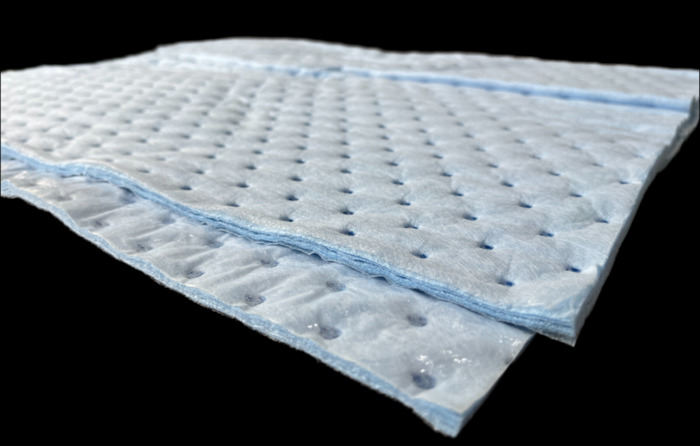
Engine blocks, presses, lathes, and hydraulic housings accumulate layered deposits of motor oil, cutting fluid, and metal shavings that ordinary rags smear around rather than lift off. This is the most common — and most underestimated — cleaning task on a factory floor, because the wrong material either falls apart under repeated scrubbing or leaves behind lint that contaminates the next process step.
Recommended product: Oil Absorbent Spunlace Nonwoven Material is built for exactly this job. Its fiber structure is engineered for high tensile strength when wet, so it holds together through repeated wiping passes on rough, oily metal surfaces instead of tearing apart like standard rags. The absorbent core pulls oil and cutting fluid into the fabric rather than pushing it across the surface, which means fewer wipes per job and less oil re-depositing on clean areas.
Selection tip: For light surface oil and routine wipe-downs, a single pass is usually enough. For baked-on or layered grease — the kind you find on engine blocks during overhaul — plan for a pre-soak or solvent-assisted pass, and use a higher-density roll or box format to reduce mid-job changeouts.
A spill on a factory floor or dock is a different problem from routine wipe-down cleaning — it’s about containment speed and holding capacity, not scrubbing power. Slippery floors around machinery and gangways are also a direct safety hazard, so the material needs to do double duty: soak up volume fast and keep the footing underneath it secure.
Recommended product: Anti Slip Oil Absorbent Pads are designed for this exact use case. The textured, non-slip surface stays stable underfoot even when saturated, which matters in walkways, near machinery bases, and on deck areas where a wet, slick pad becomes its own hazard. The pad’s absorbent core is built to hold a high volume of oil or hydraulic fluid without leaking through, so it can sit in place during a maintenance job rather than needing constant replacement.
Selection tip: Standard pad sizes cover most spot leaks and routine machinery maintenance. For larger open areas — engine rooms, bilges, or extended dock sections — custom-cut sizing is usually more practical than piecing together multiple standard pads (see the case study below).
Circuit boards, optical components, and aerospace assemblies can be damaged by the exact thing that makes a wipe good for greasy machinery: fiber shedding. A single loose fiber on a PCB or a scratch on a lens coating can turn into a failed unit further down the line. These environments need a wipe that’s non-abrasive, low-linting, and chemically compatible with solvents like IPA without breaking down.
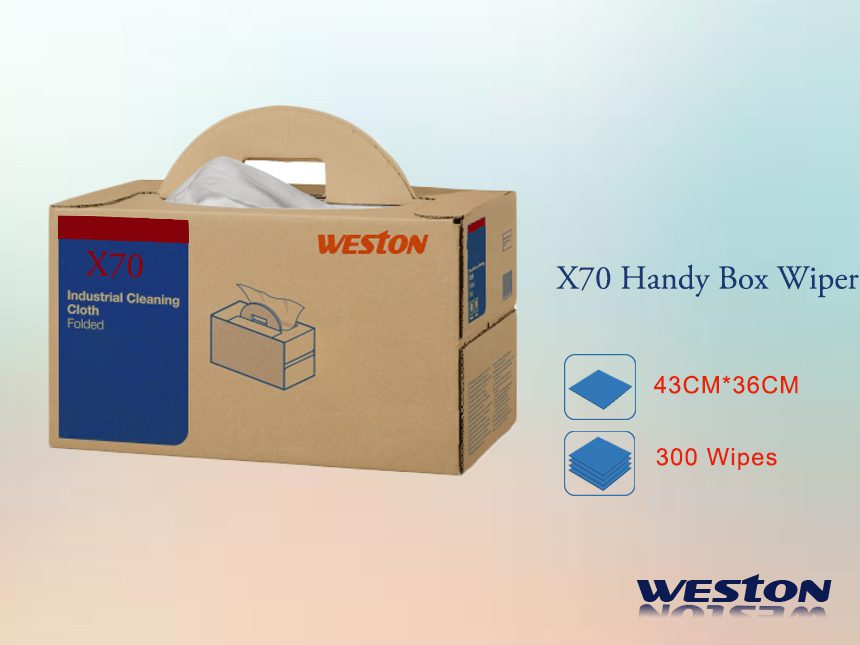
Recommended product: Woodpulp Polyester Lint Free Aerospace Wipes combine a woodpulp core for absorbency with a polyester structure that holds together under solvent use and doesn’t shed fibers onto the surface being cleaned. That makes them suitable for wiping down flux residue on assembly lines, cleaning optical and sensor components, and general precision wipe-downs where lint contamination is a rejection risk.
Selection tip: If the wipe will contact a bare board or optical surface, prioritize the lowest-lint grade available and pair it with a solvent-compatible handling process — dry wiping alone often isn’t enough to fully lift flux residue or fingerprint oils.

Not every wipe-down is about heavy grease or precision components — most day-to-day cleaning is general surface maintenance: machine exteriors, workbenches, floors, and equipment housings that need to be kept clean and presentable without a specialized material for every task.
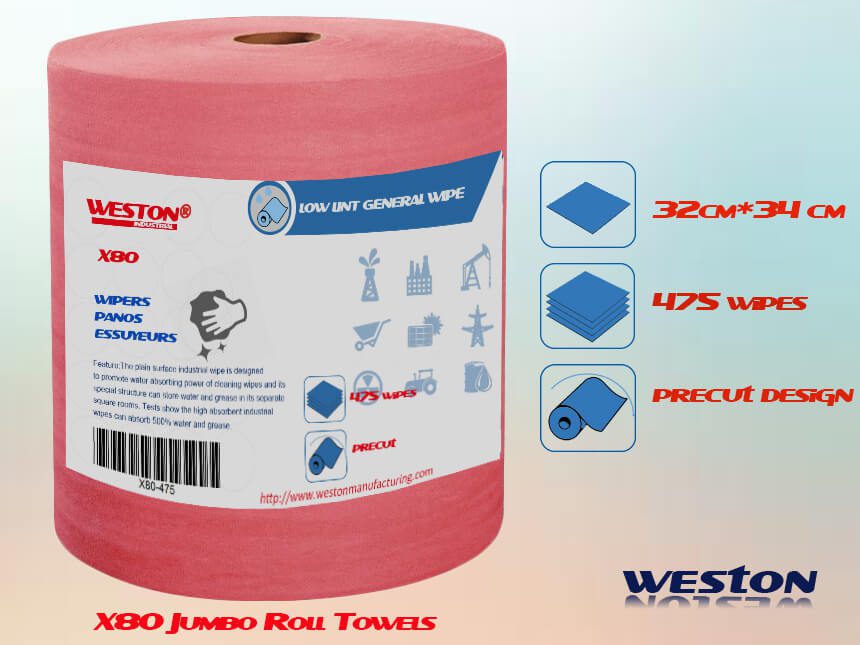
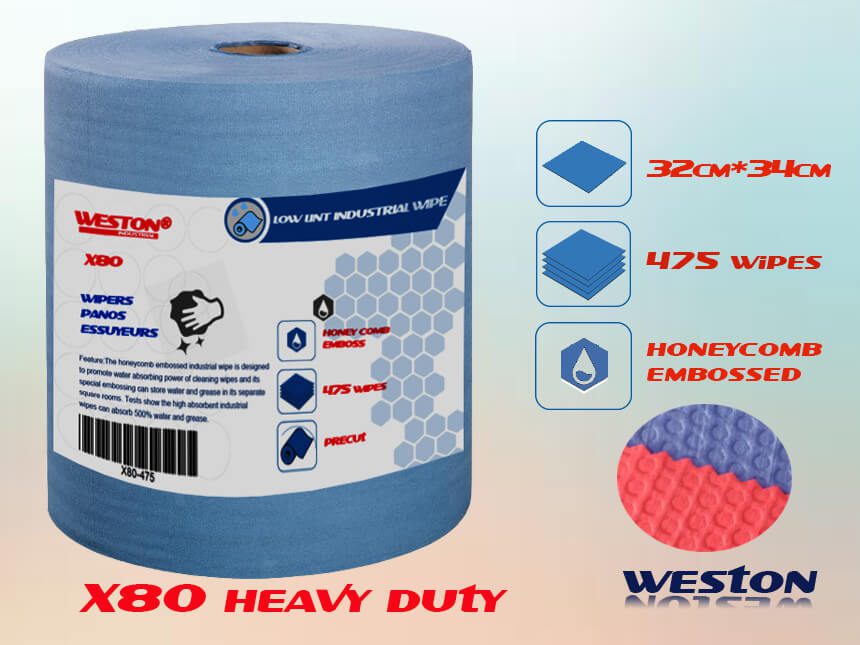
Recommended product: Industrial Meltblown Wiping Cloths are built as a general-purpose workhorse — absorbent enough for routine spills and surface dust, durable enough to hold up over a full shift, and cost-effective enough to use as the default wipe across a facility rather than reaching for a specialty product for every task.
Selection tip: Keep these stocked as the default at workstations and break areas, and reserve the scenario-specific products above for the jobs that actually need them — it keeps consumable costs down without compromising results where precision or heavy-duty performance matters.
A UK-based shipping company needed to manage oil exposure across large deck and engine room areas — spaces where standard pre-cut absorbent pads left gaps and required constant replacement to keep coverage consistent. Rather than fitting their operation to a standard product size, they came to Weston with the dimensions their vessels actually required.
Our team produced custom-sized oil absorbent pads and booms built to the client’s specified measurements, allowing continuous coverage across the larger deck sections without the seams and overlap issues that come from combining multiple standard-sized pads. The client reported that the custom sizing made deployment faster and reduced the number of individual pads needed to cover the same area, simplifying both storage and handling on board.
This is a capability we offer beyond our standard product line: if your facility’s layout or vessel configuration doesn’t match a standard pad size, we can produce custom dimensions to match your actual working area.
| Scenario | Primary Challenge | Recommended Material | Key Property |
| Heavy grease & oil removal | Adhesion of baked-on residue | Oil Absorbent Spunlace Nonwoven Material | High wet tensile strength |
| Spill containment | Volume + slip hazard | Anti Slip Oil Absorbent Pads | Textured, non-slip surface |
| Precision/electronics cleaning | Zero fiber shedding | Woodpulp Polyester Lint Free Aerospace Wipes | Low-lint, solvent-compatible |
| General surface wiping | Everyday durability & cost | Industrial Meltblown Wiping Cloths | Absorbent, cost-effective |
For hydraulic fluid and motor oil buildup on machinery surfaces, a high-wet-strength oil absorbent spunlace material holds up better than standard rags across repeated wiping passes and won’t shed fibers back onto the cleaned surface.
Use an absorbent pad with a textured, non-slip top surface positioned directly under and around the leak source — this addresses both the fluid volume and the footing risk at the same time, rather than treating them as separate problems.
Yes. Standard pad and roll sizes cover most maintenance needs, but for large or irregular areas, custom-cut dimensions reduce seams, overlap, and the number of individual units needed — we’ve supplied custom sizing for marine clients with exactly this requirement.
Low fiber shedding and solvent compatibility are the two things that matter most. A wipe that leaves lint behind, even in small amounts, creates contamination risk on bare boards or optical surfaces.
Not sure which material fits your application? Contact our team with your specific contamination type, surface, and area size — including custom dimensions — and we’ll recommend the right fit.
WESTON
Privacy Policy | SiteMap
Copyright WESTON