- Email: [email protected]


Walk into any sportswear store or industrial supply warehouse, and you are stepping into a silent war. On one side, you have Polyester—the undisputed heavyweight champion of the textile world. It is in your curtains, your cheap t-shirts, and likely the carpet under your feet. On the other side is the challenger: Polypropylene (often just called “PP”).
You’ll hear sales reps claim one is “superior” to the other. That is usually marketing fluff. In material science, “better” is a dangerous word. A Ferrari isn’t “better” than a tractor if you need to plow a field.
To really understand these two giants, we need to strip away the branding and look at the molecules. We need to look at how they handle sweat, heat, oil, and the brutal reality of daily use.

The biggest difference between these two isn’t how they look; it’s how they interact with water. This is where the debate usually starts and ends.
Polyester is a bit like a sponge that’s been wrapped in plastic. It is hydrophobic (water-fearing) compared to cotton, but it still absorbs a tiny amount of water—roughly 0.4% of its weight. That sounds negligible, but it’s enough to allow for some chemical bonding, which is why polyester is relatively easy to dye and finish.
Polypropylene, however, is chemically an olefin. It is a true plastic in the strictest sense. Its moisture regain is virtually 0%. It is not just hydrophobic; it is hostile to water. If you look at PP fiber under a microscope after a rainstorm, the water isn’t inside the fiber; it’s trapped between the fibers.
Why does this matter? Because of thermal conductivity. Water conducts heat 25 times faster than air. If your shirt holds water (like cotton) or even a tiny bit (like standard polyester), that moisture saps your body heat. Because PP holds zero water, it is the best insulator of any synthetic fiber. It keeps the warmth in by keeping the conductive moisture out.
If Polypropylene is so good at staying dry, why isn’t every gym shirt made of it?
Here is the trade-off nobody puts on the hangtag. While PP repels water, it absolutely loves oil. It is oleophilic. Human sweat is a mixture of water, salts, and body oils. When you wear a PP base layer, the moisture is pushed away instantly (great!), but the body oils latch onto the plastic fibers like a magnet (not so great).
This is the source of the infamous “perma-stink” in older synthetic gear. The bacteria that cause body odor feed on those trapped lipids. Polyester also suffers from this, but less severely than PP. Polyester washes easier. PP requires vigorous washing with warm (not hot!) water to break that oil bond, yet its low melting point makes it risky to throw in a hot wash.
If you are looking for equipment that needs to survive the apocalypse, the winner depends on where that apocalypse is happening.
Polyester is the survivor of heat and light. It has a high melting point (around 260°C). You can iron it, tumble dry it, and leave it in the back window of your car. More importantly, polyester is naturally resistant to UV radiation. It doesn’t break down easily in sunlight.
Polypropylene is the vampire of textiles. It hates the sun. Standard, untreated PP chains will degrade rapidly when exposed to UV light—literally turning into dust after a few months of intense exposure. It also melts at a relatively low temperature (around 160°C). If you toss a 100% PP shirt into a high-heat industrial dryer, it might come out two sizes smaller or hard as a rock.
However, PP wins on chemical inertia. It is incredibly resistant to acids and alkalis. If you spill battery acid on a nylon carpet, it burns. On a PP carpet? It likely just sits there. This makes PP the king of “messy” environments—basements, labs, and entry mats.
While we obsess over shirts and carpets, the real innovation is happening in places you don’t see: industrial cleaning and nonwovens. This is where engineers stop fighting the differences and start combining them.
In the world of industrial wipes and filtration, manufacturers have realized that pure plastic often isn’t enough. You need the scrubbing power of synthetics combined with the absorbency of nature.
This is where spunlace technology comes in—blasting fibers together with high-pressure water jets. By engineering specific blends, factories like Weston Manufacturing are creating hybrids that do what single fibers can’t.
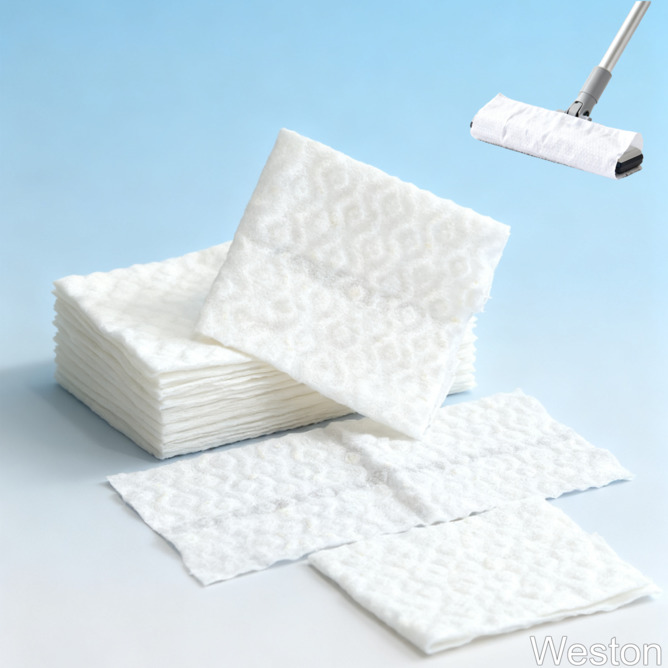
Take High Friction Polyester Wood Pulp Material, for example. By blending tough polyester (for the backbone and scrub strength) with wood pulp (for absorbency), you get a wiper that feels like cloth but scrubs like a synthetic. The polyester provides the “bite” or friction needed to remove dried grease without tearing, while the pulp holds the solvent.
On the other side of the spectrum is the Water Absorbent PP Wood Pulp Spunlace Nonwoven. This sounds like a contradiction—using hydrophobic PP to absorb water? But it’s actually genius engineering. The polypropylene provides an oleophilic skeleton that grabs grease and oil, while the wood pulp component sucks up the water. It creates a dual-action cleaning matrix that targets both oil-based grime and water-based spills simultaneously.
These aren’t just “fabrics”; they are engineered tools.
We can’t talk about plastic without talking about the planet.
Polypropylene has a surprisingly good environmental story during production. It requires less energy to manufacture than polyester and generates fewer carbon emissions. Because it is often “solution dyed” (color is added while the plastic is liquid), it uses almost no water in the dyeing process. Compare that to polyester dyeing, which is one of the most water-polluting processes in textiles.
However, Polyester wins on the back end. We have a massive, global infrastructure for recycling PET (water bottles) into fiber. Recycled polyester (rPET) is everywhere. Polypropylene is 100% recyclable, but the collection infrastructure just isn’t there yet for most consumers.

So, is Polypropylene better?
Yes, if:
No, if:
At the end of the day, the “best” fabric is the one that solves your specific problem. If you’re unsure which engineered blend is right for your specific industrial application, sometimes you just need to feel the material yourself. You can grab a free sample from the experts at Weston by dropping a line to [email protected]. Don’t guess with chemistry—test it.

WESTON
Privacy Policy | SiteMap
Copyright WESTON