- Email: [email protected]


If you’ve ever packed for travel, gone camping, or hit the gym, you’ve probably used a quick dry towel — that lightweight, ultra-absorbent fabric that dries in a fraction of the time compared to a traditional bath towel. But what gives these towels their fast-drying properties? The secret lies not only in the type of fiber used, but also in how those fibers are engineered and bonded.
This article explores the science behind quick-dry materials, the most common fibers used in their production, and how innovative nonwoven technology — such as spunlace fabrics developed by Weston Manufacturing — is shaping the next generation of quick-drying textiles.
Quick dry towels are designed to wick moisture away quickly while resisting the growth of bacteria and mildew. Different materials achieve this in distinct ways — some through fine synthetic filaments, others through natural fiber structure.
Here’s a look at the most common materials used on the market today:
| Material Type | Origin | Moisture Absorption | Drying Speed | Texture & Typical Uses |
| Microfiber (Polyester + Polyamide) | Synthetic blend | Excellent | Very fast | Smooth, ideal for travel and sports towels |
| Bamboo Fiber | Natural regenerated cellulose | High | Fast | Silky feel, antibacterial, eco-friendly bath towels |
| Cotton (Combed/Turkish) | Natural fiber | High | Moderate | Soft and plush, used for home and spa |
| Lyocell (Tencel) | Plant-based | Moderate | Fast | Smooth luxury fabrics, biodegradable |
| Spunlace Nonwoven Blends | Natural + synthetic mix | Adjustable | Very fast | Multi-use disposable towels, cleaning wipes |
Each material balances absorbency, softness, and drying performance differently. The best option depends on whether the towel is intended for reusability, portability, or industrial applications.

Drying speed is largely a result of fiber diameter, density, and surface area. Microfibers, for example, are thinner than a human hair, which allows water to spread across a greater surface and evaporate quickly.
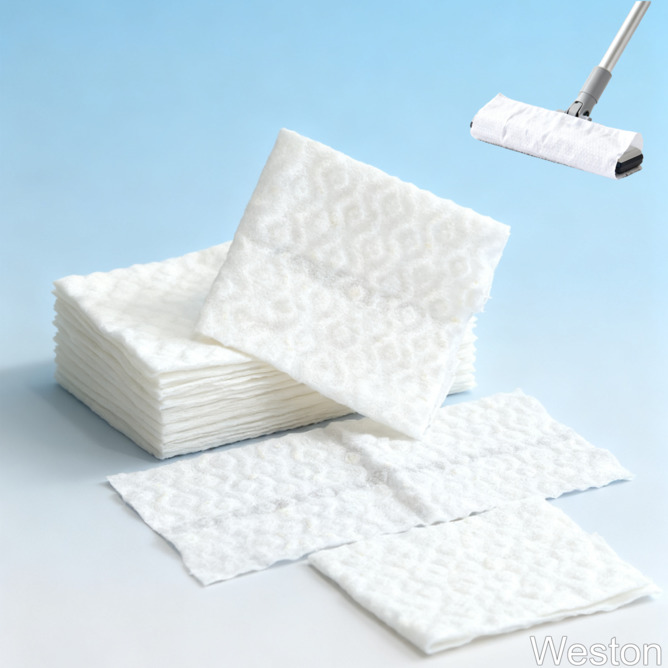
Similarly, spunlace nonwoven fabrics — made by entangling fibers with high-pressure water jets — have a unique porous network that enhances airflow and capillary action. This open structure not only speeds up drying but also makes the fabric lightweight and lint-free, ideal for disposable or high-performance towels.
Meanwhile, denser fabrics like cotton hold more water between their loops, making them heavier and slower to dry. This is why synthetic or blended towels outperform traditional cotton when time and portability matter.
The growing demand for environmentally responsible products has led to the use of biodegradable and plant-based fibers in modern quick-dry towels. Materials such as bamboo, PLA (polylactic acid), and lyocell have become popular choices for brands seeking to reduce plastic content without sacrificing performance.
These materials are not only quick-drying but also naturally breathable and antibacterial, offering a sustainable alternative to fully synthetic microfiber towels. Advances in hydroentanglement and nonwoven technology have made it possible to combine these fibers into hybrid structures that dry fast while maintaining softness and strength.
Weston Manufacturing develops spunlace nonwoven fabrics designed for rapid moisture release and consistent softness across multiple applications. Through precise control of fiber blend ratio, fabric GSM, and embossing patterns, the company produces high-performance materials used in:
Quick-dry travel and bath towels
Disposable spa and hospitality towels
Automotive and industrial cleaning wipes
These spunlace nonwoven fabrics combine high absorbency with quick evaporation, offering a balance between performance and sustainability. For sampling and customization inquiries, contact [email protected].
When selecting a quick dry towel, look for these key features:
Fiber Composition: Microfiber and spunlace blends dry the fastest.
Weight (GSM): Lower GSM fabrics dry quicker than heavy ones.
Breathability: Open, porous structures allow air to circulate freely.
Finish and Treatment: Antibacterial or odor-resistant finishes enhance usability.
Purpose Fit: Choose lightweight microfiber for travel, or eco bamboo blends for daily use.
A quick dry towel’s performance comes down to material science and fiber engineering. From microfibers that wick moisture at lightning speed to innovative spunlace nonwoven blends that combine sustainability with efficiency, the fabric’s structure determines how fast it dries.
Thanks to continuous research and fiber innovation from producers like Weston Manufacturing, today’s quick dry towels are not only lightweight and durable but also environmentally conscious — proving that advanced textile design can make everyday essentials both smarter and greener.

WESTON
Privacy Policy | SiteMap
Copyright WESTON